Two store managers moved to remove my eighty-two-year-old mother from a Main Street department store—until a young clerk found her name sewn inside the gown.
“Mom, please, just tell me why we’re here.”
She didn’t answer me.
She just kept walking, one careful step at a time, past the glass doors and the cosmetics counter, with her old leather purse clutched under one arm and her cane tapping the polished floor.
She looked small in that store.
Not weak. Not helpless. Just… easy to dismiss.
Her coat was ten years old. Her shoes were sensible. Her gray hair had been pinned back in the same simple way for as long as I could remember.
To the women behind the counter, she probably looked like somebody’s confused grandmother who had wandered in from the cold.
I saw the looks right away.
One cashier leaned toward another. A man by the escalator picked up a phone. A saleswoman in designer heels glanced at my mother’s coat, then at her hands, then quickly away.
Mom didn’t notice.
Or maybe she did, and she was too proud to show it.
She made her way to the formalwear section like she already knew exactly where she was going.
Then she slowed down even more.
Her fingers moved over the dresses one by one, touching satin, lace, and velvet like she was reading Braille. She turned a sleeve inside out. Ran her thumb over a hem. Checked the stitching at the collar of a cream-colored gown.
I knew that look on her face.
It was the same look she used to get at the kitchen table when I was a boy and she stayed up past midnight doing alterations for neighbors. Prom dresses. Church skirts. Wedding hems. She made beauty for other people while wearing the same two house dresses herself.
Then she stopped.
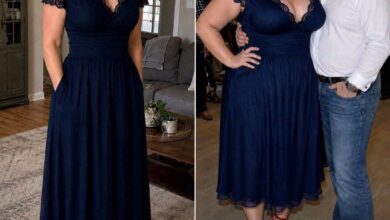
In the front display window stood a midnight-blue gown under soft lights. Long, elegant, hand-finished, with a high collar and tiny covered buttons that ran down the back like a row of pearls.
A little sign beside it read:
**From the Mercer & Reed Heritage Collection. Fall 1984. One of One.**
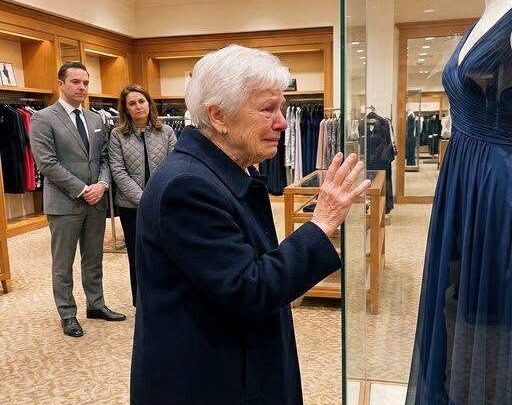
My mother lifted her hand and pressed it lightly to the glass.
Her eyes filled so fast it scared me.
That was when the first manager showed up.
He had a nice suit, a tight smile, and the kind of voice people use when they want to sound polite while telling you to leave.
“Can I help you ladies and gentlemen with something?”
“She’s with me,” I said. “We’re fine.”
He nodded, but he didn’t move.
Then security arrived. Young guy. Earpiece. Hands folded in front of him like my mother might suddenly steal a mannequin.
Mom still didn’t look at any of them.
She was staring at that blue dress like it was a person she had loved once and buried.
The second manager came up beside the first.
Now there were three people around my mother.
Three.
For an old woman with a cane and arthritic hands.
One of the sales clerks had been watching from a distance. She looked younger than my daughter. Maybe twenty-three. No judgment on her face. Just curiosity.
She walked straight to the display.
“Wait,” she said.
One of the managers started to object, but she was already opening the case.
She carefully lifted the gown from the mannequin and turned the collar back.
Then she froze.
She bent closer to the inside lining.
Looked at my mother.
Looked back at the stitching.
“Ma’am,” she said softly, “is your name Evelyn Moore?”
My mother blinked.
“It used to be Evelyn Morrow,” she said. “Before I remarried.”
The clerk swallowed hard. She turned the lining outward so all of us could see it.
There, hidden in tiny hand-sewn letters, almost too fine to notice, were the words:
**Made by hand by E. Morrow
Mercer & Reed
September 1984**
Nobody said anything.
Not the managers. Not security. Not the women at the register.
My mother had made that dress.
Forty-one years ago, in the upstairs workroom of that very store, back when formal gowns were still cut by hand and women like her sat for hours under hot lights, sewing beauty into other people’s lives without ever putting their names on the front.
The young clerk looked like she might cry.
“You made this?”
Mom gave the smallest nod.
“I made twelve for the winter collection that year,” she said. “This is the only one I ever saw again.”
The first manager’s whole face changed.
Security took a step back.
And my mother—my proud, stubborn, quiet mother—reached for the gown with both trembling hands.
The clerk placed it in her arms as gently as if she were handing over a newborn child.
Mom touched the collar first.
Then the buttons.
Then the seams.
Every stitch still perfect.
She smiled, but it was the kind of smile that hurts to look at.
“I wanted to see it before my hands forgot,” she whispered.
I felt my throat close up.
Mom has arthritis so bad now she can barely hold a coffee cup some mornings. She used to thread a needle without glasses. Used to turn cheap fabric into something women cried over in fitting rooms.
Now opening a jar can leave her in tears.
The store had gone silent.
Real silent.
Not shopping silent. Church silent.
The security guard cleared his throat. “Ma’am… I’m sorry.”
I looked at him and said, “That’s the problem. You saw an old woman standing too long in front of something beautiful, and your first thought was that she didn’t belong near it.”
No one argued with me.
Because no one could.
The young clerk asked Mom, “Why today?”
Mom kept her eyes on the dress.
“Because some days I remember everything,” she said. “And some days I don’t. Today I remembered every stitch.”
Then she laid her cheek against the blue silk and laughed through her tears.
“Hello, old girl,” she said. “You held up better than I did.”
That broke me.
I stood there in the middle of that store and cried like a child.
And all I could think was this:
Every older person you pass has a whole country inside them.
Factories. Farms. Classrooms. Kitchens. Army bases. Sewing rooms. Night shifts. Assembly lines. Babies rocked to sleep. Clothes mended. Houses built. Lives held together.
And now we look at their slow steps, their old coats, their shaking hands, and act like they arrived here empty.
My mother didn’t come to that store to shop.
She came to visit a piece of herself the world had almost forgotten.
And for one long, quiet minute, the world remembered.
PART 2
That minute did not last.
The elevator doors opened behind us with a hard metallic chime, and a man in a dark suit came across the floor so fast his shoes clicked like anger.
He wasn’t store-floor staff.
You could tell.
He had that cleaner look.
That polished distance.
The kind of face that only ever has to deal with problems after somebody else has already made them.
He took one look at my mother holding the midnight-blue gown and said, sharp as a slap:
“Put that dress back in the case.”
Nobody moved.
Not my mother.
Not the young clerk.
Not me.
The whole floor had gone too still for that.
The first manager turned toward him right away.
“Mr. Cross, sir, we just discovered—”
“I heard there was a disturbance,” the man said. “That piece is insured. It’s scheduled for tonight’s heritage preview. Put it back.”
He said piece.
Not gown.
Not dress.
Not the thing my mother had cut, basted, pinned, shaped, lined, and finished with her own hands.
Piece.
Inventory.
Something under glass.
My mother looked at him then.
Really looked at him.
Her eyes were wet, but there was nothing weak in them.
“Before I put it anywhere,” she said quietly, “I’d like to know if you always speak about women’s work like it belongs to the building more than the woman who made it.”
You could have heard a pin drop into a sock.
The young clerk swallowed hard.
She still had one hand near the opened case like she was afraid they were going to blame her for all of it.
Mr. Cross looked at the tiny lettering in the lining where the clerk had turned the fabric out.
His whole expression shifted.
Not enough to make me like him.
But enough to tell me he understood this wasn’t going away.
“Who are you?” he asked my mother.
She straightened as much as her back would let her.
“Evelyn Morrow,” she said. “Later Moore. And if you know anything at all about the room upstairs, you’ll know I am not asking who you are. I’m asking whether it’s still there.”
He blinked.
The first manager frowned.
“What room?” he asked.
My mother kept her eyes on Mr. Cross.
“The sewing room,” she said. “Third floor. Back of the old stock hall. Two windows facing the alley. Radiator that hissed all winter and clanged like a ghost every February.”
Mr. Cross hesitated.
And that hesitation told me more than any answer.
My mother saw it too.
“It’s still there,” she said.
He cleared his throat.
“It isn’t in use.”
“That wasn’t the question.”
He glanced at the little crowd that had gathered at the edge of formalwear.
People pretending not to stare.
Two women with shopping bags held against their coats.
A man in a knit cap with his phone halfway raised.
A teenage girl clutching her mother’s arm.
The kind of crowd that forms when something human breaks through the polished surface of a place built to keep feelings expensive and controlled.
Mr. Cross lowered his voice.
“Mrs. Moore, perhaps we should continue this conversation in private.”
“No,” my mother said.
Not loud.
Not rude.
Just no.
It landed harder than shouting would have.
“If there is something to be said,” she told him, “say it where the apology happened.”
No one corrected her.
No one dared.
He drew a breath through his nose.
The first manager looked like he wished the floor would open and swallow him.
The security guard had gone so pale I almost felt sorry for him.
Almost.
Mr. Cross said, “I’m Daniel Cross. Regional operations director for Mercer & Reed.”
My mother nodded once like the title meant less than the thread in her hand.
“I came to see the gown,” she said. “But that isn’t all I came for.”
I turned to her.
That got my attention.
Because until then, I thought I understood why she had dragged herself into that store.
I thought this was grief.
Memory.
A final visit to something she had made before the fog in her mind grew thick enough to take it from her.
But there was something else in her face now.
Something steadier.
Purpose.
Mr. Cross said, “What else did you come for?”
My mother held the dress closer.
“For what I left behind.”
The words moved through the floor like a draft.
The young clerk whispered, “Left behind?”
My mother nodded.
“In the upstairs room.”
The first manager spoke up too fast.
“That floor is restricted.”
My mother turned her head and looked at him with the kind of tired patience older women save for men who have mistaken authority for intelligence.
“It wasn’t restricted when we were making your history in it.”
He shut his mouth.
Mr. Cross tried another tone.
Softer.
Smoother.
The voice of a man used to repairing trouble with the right phrasing.
“Mrs. Moore, the third floor is storage now. There are safety issues. Exposed fixtures. Inventory carts. I understand this is emotional, and I would be happy to arrange a proper appointment with archives.”
My mother almost smiled.
It was not a kind smile.
“Archives?” she said. “Mercer & Reed never kept archives on women like us.”
That one hit.
Because even the people who had never heard the history felt the truth in it.
Mr. Cross glanced again at the name sewn into the lining.
Then at the young clerk.
Then at me.
Then at the shoppers.
He knew he was standing in the middle of a story that had already started moving beyond his control.
A woman near the register said, not even quietly, “Let her go upstairs.”
The teenage girl said, “Yeah.”
Then the man in the knit cap said, “If she made the thing, she should be able to see the room.”
And just like that, the air changed.
Not into a riot.
Nothing ugly.
Just a line being drawn.
A simple one.
A human one.
Mr. Cross knew it too.
He exhaled.
“Five minutes,” he said. “And only with an escort.”
My mother handed the gown back to the young clerk with both hands.
“Then don’t waste them.”
The clerk looked at her like she had just been trusted with something holy.
She folded the gown over her arms and placed it back in the open case with more tenderness than I’d seen from anyone in that store all afternoon.
Mr. Cross motioned to the managers.
“To the service elevator.”
The first manager started to lead.
My mother said, “Not that way.”
Everyone looked at her.
She pointed with the tip of her cane.
“There used to be a narrow corridor behind childrenswear. The staff staircase was there.”
Mr. Cross said, “That passage hasn’t been open in years.”
“Then unlock it.”
I don’t know whether it was her certainty or the fact that she had already been right once.
Maybe both.
But he gave a small nod to one of the managers, and we went.
The young clerk came too.
Nobody told her to stay behind.
Maybe because nobody wanted to be the one who sent away the only person in that store who had actually seen my mother clearly from the start.
As we moved past the sales floor, I heard whispers blooming behind us.
Not cruel ones.
Not anymore.
The kind that come when people suddenly realize they almost became part of something shameful.
My mother walked slowly.
Cane.
Step.
Breath.
Cane.
Step.
Breath.
But there was nothing uncertain in the way she led us.
She knew every turn.
Every pillar.
Every corner where the light changed.
She was not wandering.
She was returning.
Behind childrenswear there was a paneled wall, newer than the rest, painted to disappear.
One manager unlocked it with a ring of keys.
A narrow door opened inward.
The smell that came out hit my mother so hard she stopped.
Dust.
Wool.
Old wood.
Iron heat.
It had probably been thirty or forty years since that air had touched her face.
Her eyes closed.
“Oh,” she whispered.
Just that.
Oh.
Not because it was beautiful.
Because it was hers.
I put a hand near her elbow.
She didn’t lean on me.
Didn’t need to.
She stepped through first.
The staircase was narrow and steep and painted a tired industrial gray.
The handrail was nicked smooth where a thousand palms had worn it down.
Above us, dim bulbs buzzed behind metal cages.
The place looked nothing like the polished floor downstairs.
It looked like work.
Real work.
The kind people use and hide.
Halfway up, my mother stopped again.
She ran her fingertips over the wall.
“There used to be a clock right here,” she said. “Always seven minutes fast.”
The young clerk smiled through her tears.
“Why?”
“So no one would be late after lunch.”
That got the first small laugh out of anybody.
Not from humor exactly.
From relief.
From hearing something ordinary in the middle of something enormous.
On the landing to the third floor, my mother missed the last step by half an inch.
I caught her arm.
She gripped my sleeve, steadied herself, and said, very quietly so only I could hear:
“Don’t fuss.”
That was my mother.
Eighty-two.
Hands swollen.
Memory slipping at the edges.
Still ordering me around like I was twelve and she’d just found me trying to fix the toaster with a butter knife.
The third-floor door groaned when the manager pushed it open.
The room beyond was huge and dim.
Not pretty.
Not preserved.
Certainly not archived.
A graveyard of fixtures and forgotten labor.
Rolling racks.
Broken mannequins.
Boxes of old signage.
Retired display tables.
A cracked mirror leaning against a wall.
Metal shelves bent under stacks of forms and brittle garment bags.
And in the far back, past all that clutter, behind a row of boxed lighting units, there it was.
The room inside the room.
The old workroom.
My mother saw it before anyone else did.
Her breath caught.
The windows were still there.
Tall and dirty.
Facing the alley.
The winter light through them looked tired and gray.
The radiator sat beneath one sill, massive and chipped, its paint bubbled with age.
Long cutting tables stood in rows, shoved sideways now, buried under plastic tubs and old promotional banners.
In one corner sat a dress form with no head and one arm missing.
I had never seen this room before in my life.
And somehow I knew it immediately.
Not from memory.
From her.
Because I had grown up inside the aftershocks of this place.
In the hems she mended.
In the pins she kept between her lips.
In the callus on the side of her middle finger.
In the way she always turned clothes inside out first.
In the silence she carried whenever people admired something beautiful and never once asked who had made it.
My mother took two more steps into the workroom and stopped dead.
Her hand went to her mouth.
Not dramatic.
Not theatrical.
Instinctive.
Like she was seeing ghosts and loved every one of them.
“Alma sat there,” she said, pointing with the cane.
Then to another table.
“Joanie there. Ruth by the window because she needed the light for beadwork.”
Her finger drifted farther.
“Clara took that corner after her second baby because it was closest to the washroom.”
The young clerk whispered, “You remember where everyone sat?”
My mother gave a small, startled laugh.
“I don’t remember what I had for breakfast yesterday,” she said. “But I remember where the women were.”
That one nearly undid me again.
Because that is how love works sometimes.
It fails in the small current places first.
Then holds on like iron to what built you.
Mr. Cross stood back by the doorway with his hands in his coat pockets, and for the first time he looked less like a man in charge and more like a man who had walked into a room where his title meant nothing.
My mother moved slowly between the tables.
Her fingertips skimming nicks in the wood.
Burn marks from old irons.
Tiny grooves worn by scissors and chalk wheels.
“Here,” she said softly.
And then again, a little louder.
“Here.”
I knew what she meant.
Not a place on the floor.
A place in time.
I watched her face change with every step.
Not younger.
I don’t mean that.
Memory doesn’t make old age disappear.
It just puts more light on it.
She looked more fully herself than I had seen in months.
More whole.
Even the stiffness in her shoulders seemed to give a little, like some locked door inside her had opened.
Then she made a beeline toward the radiator.
Past the first row of tables.
Past a cracked spool rack.
Past a cabinet with one drawer hanging out.
Straight to the corner under the dirt-streaked window.
Mr. Cross said, “Mrs. Moore, please be careful.”
She ignored him.
Of course she did.
She crouched as much as her knees allowed, winced, braced herself with one hand on the radiator, and tapped the baseboard with the metal tip of her cane.
Once.
Twice.
Third tap.
A hollow sound.
My heart kicked.
The young clerk looked at me with her eyes huge.
My mother said, “There.”
The manager nearest her frowned.
“There what?”
She held out her hand without looking up.
“Do any of you keep a flathead screwdriver anymore, or has modern management found a way to make do without tools altogether?”
The young clerk laughed through her nose before she could stop herself.
One of the managers flushed, dug in a nearby maintenance box, and came up with a stubby screwdriver.
My mother took it.
Her fingers shook so badly I reached down.
“Mom.”
She looked up at me.
Not angry.
Just fierce.
“I know,” she said. “Let me try first.”
I let her.
She wedged the screwdriver into a seam in the baseboard and worked it carefully.
Not with strength.
With knowledge.
There’s a difference.
The wood loosened.
An inch.
Two.
Then a narrow panel came away in her hand.
Behind it was a cavity in the wall.
Dark.
Dusty.
No bigger than a bread box.
For one awful second I thought it would be empty.
That memory had brought her all the way there for nothing.
That she had built herself around a place where nothing remained.
Then I saw the corner of a cloth-wrapped bundle.
My mother closed her eyes.
“Oh, thank God,” she said.
Not the polished, church-lady thank God she used at funerals.
A raw one.
A private one.
The kind people say when something beloved survives long enough for them to reach it.
She put the screwdriver down and looked at her hands.
They were trembling too much.
I knelt beside her.
“Can I?”
Her chin moved once.
I reached into the cavity and drew the bundle out.
It was wrapped in faded muslin and tied with old twill tape gone yellow with age.
Smaller than I expected.
Heavier too.
The fabric left dust across my hands.
My mother touched the knot with one finger like she was greeting an old friend.
“Open it,” she said.
So I did.
Inside was a ledger.
Not an official one.
Not store property with embossed gold edges and numbered pages.
This was a thick sewing notebook with a cracked burgundy cover, swollen from age, filled with swatches and handwriting and scraps tucked between pages.
On the front, in neat blue ink faded almost gray, were the words:
UPSTAIRS WOMEN
1981–1985
The young clerk made a little sound in the back of her throat.
Mr. Cross stepped forward despite himself.
The first manager said, “What is that?”
My mother answered without taking her eyes off it.
“The part you left out.”
I opened the cover.
The first page held names.
Not one.
Not five.
Dozens.
Written in different hands.
Some careful and slanted.
Some rushed.
Some with flourishes.
Some blocky and practical.
Evelyn Morrow.
Ruth Baptiste.
Alma Flores.
Joanie Pike.
Clara Donnelly.
Nina Bell.
Mae Alvarez.
Louise Turner.
On and on.
Beside each name were notes.
Not job titles.
Not employee numbers.
Lives.
Two boys at home.
Cares for her father nights.
Fastest hemmer on the floor.
Can set sleeves blindfolded.
Brings peppermint candy.
Good with brides who cry.
Needs bus fare till Friday.
Sings under her breath.
Lost a baby in March.
Still came back Monday.
The room tilted a little around me.
It was too much.
Too plain and too big at the same time.
A record of people no glossy heritage sign would ever think to make room for.
The young clerk put her hand over her mouth.
“Oh my God.”
My mother took the book from me carefully.
Her thumb moved over the first page.
“We kept it hidden,” she said. “Not because we were stealing anything. Because we were tired of disappearing.”
Mr. Cross said, more softly now, “Mrs. Moore, I had no idea this existed.”
“No,” she said. “You didn’t.”
He was quiet.
I turned more pages.
There were sketches pinned with rusted dressmaker pins.
Swatches taped beside finished notes.
Tiny pattern corrections.
Beading maps.
Sleeve revisions.
Handwritten instructions in the margins.
And every few pages, stories.
Not polished stories.
Just fragments.
Clara’s husband laid off again.
Mae’s mother in hospital.
Ruth says every gown ought to carry a hidden blessing.
Joanie burned her thumb and still beat us all on button loops.
Evelyn drafted the blue collar tonight after dinner and got it right first time.
I froze.
I looked up.
“Mom.”
She met my eyes.
I turned the page toward her.
There, on brittle paper the color of old teeth, was the original sketch of the midnight-blue gown.
The high collar.
The covered buttons.
The long line of the back.
Penciled notes in the margin.
Silk charmeuse underlining.
Hand-finish button loops.
No machine topstitching on collar stand.
Display window if approved.
And in the bottom corner, written in a different hand:
Evie’s design. Best one in the room. Don’t let the house steal it again.
—R.B.
My mother let out one hard breath.
R.B.
Ruth Baptiste.
Whoever she had been, I loved her instantly.
The first manager said, “That can’t be right.”
My head snapped up.
He looked almost startled by his own words, but he’d said them.
And that, right there, was the whole disease in one sentence.
That can’t be right.
Not because the evidence wasn’t there.
Because the story he had been handed his whole life had no space for women like my mother inventing the beauty his store still profited from.
My mother’s face changed.
Not into anger.
Into that colder thing older people get when they have heard the same dismissal for fifty years and no longer waste heat on being surprised.
“It is right,” she said. “Mercer & Reed called it house design because house design sounded elegant. What it meant was this room. It meant women paid by the hour making things rich people liked to pretend appeared by magic.”
The words hung there.
No one challenged them.
Not even Mr. Cross.
He had gone very still.
“Tonight’s preview,” my mother said.
He blinked.
“What about it?”
She held up the sketch.
“Is that gown being presented as a Mercer & Reed original from the heritage house?”
Mr. Cross hesitated just one beat too long.
That was answer enough.
My stomach dropped.
Of course it was.
Why wouldn’t it be?
The store got the myth.
My mother got arthritis.
The young clerk turned and stared at him.
“You knew?”
“No,” he said quickly. “Not this. Not the details. The collection materials came from legacy marketing copy. We inherited the language.”
My mother gave a little laugh that held no humor at all.
“There it is,” she said. “Everybody inherits the language. Nobody inherits the blame.”
That landed so hard even the radiator seemed to shut up for it.
Mr. Cross took one careful step forward.
“Mrs. Moore, I need you to understand something. The preview tonight isn’t just a store event. It’s tied to a full relaunch. The heritage collection is part of a fundraising partnership for the building restoration. Local donors, board members, press, community patrons—”
She cut in.
“Community.”
Not loud.
Just enough.
He stopped.
My mother looked around that dusty room.
At the tables.
The windows.
The old floor scarred by years of work.
Then back at him.
“This was community,” she said. “Women swapping bus money. Taking each other’s hems when one had a sick child. Saving scraps for girls who couldn’t afford confirmation dresses. Community is not a room full of people drinking sparkling water under good lighting while they clap for work they never had to do.”
The young clerk looked like she wanted to applaud.
I wanted to.
Mr. Cross rubbed a hand over his jaw.
He was not a stupid man.
That made him harder to dismiss.
Because you could see him thinking.
Calculating.
Not how to lie exactly.
How to manage the truth without letting it wreck the machine.
And I knew that look too.
I had seen versions of it my whole life.
At banks.
At hospitals.
At repair offices.
In places where people behind desks learn to speak softly while deciding how much of your pain is administratively convenient.
He said, “What do you want?”
My mother answered so fast it scared me.
“All of us named.”
He looked at the notebook.
“The women in here?”
“The women we can prove. The women we remember. The women who made what you still sell stories about.”
Mr. Cross said, “That is not a small request.”
My mother’s voice stayed even.
“No. It isn’t. Neither were our lives.”
The room went dead quiet again.
Then he did something I did not expect.
He nodded.
Just once.
“All right,” he said.
And for one beautiful stupid second I thought that was going to be it.
That he was going to do the decent thing and save all of us the blood pressure.
But then he kept talking.
“We can work toward that,” he said. “Thoughtfully. Properly. With verification. With archival review. With a statement drafted in coordination with the relaunch team.”
There it was.
Paper.
Time.
Control.
Language again.
He wasn’t refusing.
Not outright.
He was doing something worse.
He was making room for the truth only if the truth arrived dressed correctly and agreed not to disturb dinner.
My mother heard it too.
I saw her shoulders settle.
That disappointed kind of settling.
Not surprise.
Recognition.
“Coordination,” she repeated.
“We need to be careful,” he said. “There are current employees. Partnerships. Donors. A building campaign. If this turns into a claim of misrepresentation without context, people who had nothing to do with the past could get hurt.”
Now that one mattered.
Because it was not nonsense.
It was true enough to be dangerous.
The young clerk frowned.
“What current employees?”
He looked at her.
“Store staff. Alterations. Maintenance. Support teams. We’re not exactly in a booming season. If tonight collapses publicly, a lot of working people may pay for a mistake they didn’t make.”
That room got morally complicated in a hurry.
And that is where stories start cutting people clean down the middle.
Because he was not wrong.
Not entirely.
He was protecting the institution, yes.
But institutions are full of workers.
People with rent.
People with pills to buy.
People with kids.
People one bad quarter away from losing everything.
I hate that about the world.
How often it forces the injured to decide whether telling the truth is worth the blast radius.
My mother looked at the notebook.
Then at him.
Then at the young clerk.
“What is your name?” she asked the clerk.
“Leah.”
My mother nodded.
“Leah. If someone had asked you downstairs, before you found that stitching, whether I belonged near that dress, what would you have said?”
Leah’s eyes filled again.
“I would have said I didn’t know,” she admitted.
My mother smiled sadly.
“Exactly.”
Then she turned back to Mr. Cross.
“That is what your building depends on,” she said. “People not knowing.”
Mr. Cross opened his mouth.
Closed it.
Opened it again.
“What I’m asking for is time.”
My mother looked at the notebook.
“No,” she said. “What you’re asking for is ownership.”
He went still.
And that was the moment I knew she still had every dangerous part of herself.
Old age hadn’t taken that.
Pain hadn’t taken it.
Fog hadn’t taken it.
Years of being overlooked hadn’t taken it.
It was all still there.
Buried maybe.
Tired certainly.
But alive.
Mr. Cross said, “Mrs. Moore, let me make a proposal.”
I hated the word before he finished.
He looked at me too then, and I knew why.
Because he had already clocked my mother’s coat.
Her cane.
The slowness in her walk.
The little stiffness in her jaw when pain bit through.
He had seen enough life to know we were not a family swimming in spare money.
“We would like to recognize your contribution formally tonight,” he said. “Publicly. We can identify you as the maker of the blue gown. We can arrange an honorarium, archival consultation, and a longer review of the workroom history.”
Leah said, “That’s not the same thing.”
He kept his eyes on my mother.
“It’s a beginning.”
My mother did not answer.
He took one more measured breath.
“And,” he said, “if additional names can be verified from the notebook, we can discuss a broader installation later this season.”
There it was again.
Later.
Discuss.
Can.
The soft language that turns urgency into weather.
I wish I could say I stood there pure and noble and saw through every part of it.
I didn’t.
Because one word had lodged in me.
Honorarium.
Money.
Not because I wanted to be bought.
Because I knew what sat in my mother’s kitchen drawer at home.
Prescription receipts.
Heating notices.
The eye specialist referral she kept “forgetting” to schedule because she said it could wait till spring.
The estimate for fixing the roof leak over the spare room.
The grocery list with half the items crossed out before she even left the house.
Aging in this country is expensive even when you do everything right.
Especially then.
And suddenly I hated myself for thinking it, but I did think it.
If they were offering her money, real money, enough to make the next year easier—
I looked at her hands.
Those hands.
Hands that had given and given and given.
What if taking the offer was not surrender?
What if it was survival?
Mr. Cross saw something move across my face.
He knew.
Of course he knew.
The smartest kind of power can smell need before it is spoken.
He said, more gently now, “We can make sure Mrs. Moore is compensated with dignity.”
Leah turned on him.
“Compensated for what? For one dress? Or for staying quiet about the rest?”
He didn’t answer her right away.
That was answer too.
My mother closed the notebook.
The sound of it was small.
Final.
“Take us downstairs,” she said.
Mr. Cross frowned.
“Mrs. Moore, I think it would be wiser if—”
“Take us downstairs.”
He looked at her a second longer.
Then nodded.
Nobody spoke on the way back down.
The room had gotten heavier than words.
My mother kept the notebook in both hands all the way to the sales floor.
Leah walked beside her.
I stayed one step behind.
Protective and ashamed and confused in ways I did not yet have language for.
Because love does not always make you brave first.
Sometimes it makes you practical.
Sometimes it makes you afraid.
The shoppers were still there when we came back.
Not all of them.
Enough.
The young security guard straightened when he saw my mother.
His face had gone from professional caution to something like reverence.
The blue gown had been returned to the case.
Its collar straight.
Its buttons gleaming under the lights.
Mr. Cross spoke low to one of the managers and the man hurried away.
Then he turned back to my mother and said, “A car will take you home if you’d like. We’ll be in touch within the hour.”
My mother said, “No car.”
He blinked.
“I insist.”
She gave him the plainest answer in the world.
“That’s how these things start.”
Leah made a sound that might have been a laugh if the situation hadn’t been slicing everybody open.
Mr. Cross handed me a business card.
Generic cream stock.
Name in clean dark lettering.
A number.
An email.
A title.
All the little symbols of modern importance.
I slipped it into my pocket without looking at it.
Then my mother did something no one expected.
She turned back to the display.
Not to hold the gown again.
Just to stand in front of it one last time.
The floor went quiet.
She looked at the dress.
Then at her reflection in the glass.
The old woman in the worn coat.
The long elegant shape under lights.
The years between them like a river.
And she said, not to any of us, “I was twenty-nine.”
Leah whispered, “When you made it?”
My mother nodded.
“I had a fever that week. Your grandfather had the croup. I stitched the collar after midnight because the house line supervisor wanted it softened and she was wrong, so I redid it once she left.”
I stared at her.
“You never told me that.”
She kept looking at the glass.
“No one asked.”
That one hit me the hardest of all.
Because it was not accusation.
Just fact.
No one asked.
I don’t know which part of adulthood hurts more.
Learning your parents kept entire continents folded up inside them.
Or realizing how often you mistook their silence for emptiness.
We left through the front doors five minutes later.
Cold air hit us.
The street was going blue with early evening.
Main Street lights coming on.
Cars hissing past on wet pavement.
My mother walked slower now.
Not because the fire had gone out.
Because fire costs.
I took her arm before she could protest.
This time she let me.
At the curb she said, “I’m tired.”
That scared me more than anything else that day.
Because my mother only admitted tired when she was nearly through.
I opened the truck door and helped her in.
Leah came out after us, coat half-buttoned, cheeks pink from hurrying.
She stopped by the passenger window.
“I’m sorry,” she said.
My mother looked up at her.
“For what?”
“For all of it. For not knowing. For how they looked at you. For how this place—”
My mother lifted a hand.
“Don’t apologize for what you didn’t build,” she said. “Just don’t help it keep standing.”
Leah nodded like she’d been handed an instruction she meant to live by.
Then she looked at the notebook in my mother’s lap.
“If they call tonight,” she said, “don’t let them make you into a poster.”
My mother’s mouth twitched.
“You think they’ll try?”
Leah looked back through the store windows.
“They already are.”
When I started the truck, my hands were shaking.
I didn’t trust myself to speak until we were halfway home.
Main Street gave way to smaller roads.
Then the row of old duplexes.
Then the grocery with the flickering sign.
Then the neighborhood where porches sag and people still wave because no one here has enough left to waste on pretending otherwise.
My mother kept the notebook in her lap the whole ride.
One hand resting on it.
Like a person protecting a sleeping thing.
Finally I said, “What did you mean up there?”
She turned her head slowly.
“What part?”
“When you said you came for what you left behind.”
She looked down at the cover.
“Ruth called me two weeks before she died,” she said.
That surprised me so much I nearly missed the stop sign.
“Ruth Baptiste?”
My mother nodded.
“I hadn’t spoken to her in years. Not properly. Christmas cards for a while. A church funeral once. Then life happened to both of us.”
Her thumb rubbed the edge of the notebook.
“She said she’d had a dream about the blue gown. About the old room. Said she kept thinking of the book and worrying some renovation would swallow it.”
I glanced at her.
“You never told me.”
“I wasn’t sure I remembered where we hid it.”
“Why now?”
She smiled without humor.
“Because three mornings ago I stood in my own kitchen and could not remember why I had opened the flour tin. I looked right at it and felt like a stranger in my own house.”
I gripped the wheel harder.
She kept going.
“But when I thought of that room, I remembered the third tap on the baseboard clear as the Lord’s Prayer.”
She turned the notebook slightly so the fading letters caught the light.
“I knew if I waited too long, one of the memories would win.”
I did not know what to say to that.
So I drove.
And she sat beside me with forty years in her lap.
When we pulled into her driveway, there was already a car parked behind the little hedge.
My daughter’s car.
I blinked.
“What’s Emma doing here?”
My mother looked out the windshield.
“Probably because somebody in that store already posted us.”
She was right.
Of course she was.
By the time we got inside, Emma was in the kitchen with her coat still on, phone in hand, eyes huge.
“There you are,” she said. “Are you okay?”
She came straight to my mother first.
Bent down.
Kissed her cheek.
Then looked at me.
“Do you know this is everywhere?”
I hated the word everywhere.
In the modern world it can mean fifteen thousand strangers having opinions before you’ve even taken your shoes off.
“What is?” I asked.
Emma held up her phone.
On the screen was a shaky vertical video of my mother touching the lining of the gown while Leah read the stitched name aloud.
No audio at first.
Then another clip.
My voice, raw and angry:
You saw an old woman standing too long in front of something beautiful, and your first thought was that she didn’t belong near it.
Great.
Just great.
My mother sank into the kitchen chair like her bones had liquefied.
Emma set the phone down.
“It’s spreading fast.”
My mother frowned.
“Spreading where?”
“Online.”
My mother sighed.
“Well. That sounds contagious.”
That got a laugh out of me in spite of everything.
Emma crouched by her chair.
“Grandma, people are furious. At the store. At how they treated you. But they’re also saying beautiful things. About older women. About invisible labor. About their mothers and grandmothers.”
My mother shrugged off her coat with difficulty.
“People always say beautiful things right after they almost do something ugly.”
I went still.
Because there it was again.
My mother’s whole worldview in one sentence.
Emma saw the notebook then.
“What is that?”
I set it on the table and opened to the first page.
Emma’s face changed the same way Leah’s had.
Not just surprise.
Recognition of scale.
“That’s all of them?”
“Some of them,” my mother said. “The ones who wrote themselves down.”
Emma touched one of the names very gently.
Like she might smear time if she pressed too hard.
For the next half hour we sat in that kitchen reading pages.
Not all.
We couldn’t.
There were too many.
Too much.
The room got full of women I had never met and somehow already missed.
Ruth Baptiste, who did beadwork by the window and believed every dress ought to carry a blessing.
Clara Donnelly, who kept spare stockings in her lunchbox because she never knew when somebody would split a seam and cry.
Mae Alvarez, who took bus transfers from three different lines and still beat everyone in before the clock.
Joanie Pike, who made button loops so fine they looked machine-made and hated being praised for them because “praise never adds to the paycheck.”
My mother would stop every few pages and tell a story.
Tiny things.
Ruth keeping peppermints in her apron.
Alma singing under her breath while she cut bias strips.
Louise carrying a radio the size of a loaf of bread so they could hear the afternoon weather and know if the buses would be late.
How the women pooled coins for one another.
How a broken hem on a prom dress once kept three of them there till midnight because they knew the girl’s mother had saved six months for it.
How the house line supervisor never remembered a single first name below her own desk.
I sat there listening, and the whole American lie about self-made anything kept peeling farther and farther off in my mind.
Nothing elegant makes itself.
Nothing lasting does.
There are always hands.
Usually female.
Usually tired.
Usually unnamed.
At six-thirty my phone rang.
Unknown number.
We all looked at it.
I didn’t want to answer.
I did anyway.
“Hello?”
“Mr. Moore, Daniel Cross.”
Of course.
His voice sounded even smoother over the phone.
The kind of smooth that makes me instantly suspicious.
“I’m calling first to apologize again for what happened in the store today.”
I said nothing.
He went on.
“I’ve spoken with our heritage team. We would like to invite Mrs. Moore as an honored guest to tonight’s preview. We can arrange comfortable seating, transportation, and a formal acknowledgement of her authorship of the blue gown.”
There was that word again.
Authorship.
As if design came with fewer pinpricks when you said it in a better suit.
I put him on speaker.
My mother nodded for me to do it.
Mr. Cross continued.
“In addition, Mercer & Reed is prepared to offer Mrs. Moore a consulting fee for archival assistance as we review the notebook and related materials.”
Emma mouthed, How much?
I held up a hand.
Mr. Cross took a breath.
“And we would like to discuss acquisition of the notebook for preservation.”
There it was.
Acquisition.
Not donation.
Not partnership.
Not shared custody of history.
Acquisition.
My mother leaned toward the phone.
“For how much?” she asked.
He named a number.
I won’t write it here because the amount matters less than what it did to the room.
It was enough.
Not rich enough to change a life forever.
Enough to change a year.
Enough to fix the roof.
Enough to cover treatments.
Enough to make old age less cruel for a while.
Emma looked at me.
I looked at my mother.
And here is the part I am not proud of.
I wanted her to say yes.
Not because I wanted them to win.
Because I wanted her eased.
I wanted the next winter softer.
I wanted the pills bought without calculation.
I wanted her to stop pretending canned soup was “all she felt like” when I knew full well she was stretching groceries.
Love and compromise share a hallway more often than people like to admit.
Mr. Cross said, “If Mrs. Moore is comfortable attending, we can also discuss a permanent recognition plan after tonight.”
My mother asked, “Do I get to speak?”
A pause.
Not long.
Just long enough.
“Briefly, yes.”
That told us everything.
Briefly.
Contained.
Netted.
My mother sat back.
“What about the other names?”
“We are not in a position to verify them all by this evening.”
“What about saying that publicly tonight?”
Another pause.
Then: “I believe it would be wisest to center Mrs. Moore’s story first.”
My mother stared at the phone like it had insulted her in person.
“Center,” she said.
Mr. Cross rushed gently into the silence.
“This is an opportunity, Mrs. Moore. To restore your name to an important piece of the house history.”
My mother’s face closed.
She looked older in that second than she had in the workroom.
Not weaker.
Just more tired of the same old trick dressed in newer language.
She said, “I’ll call you back.”
And hung up.
Emma whistled softly.
“Well.”
The room sat there.
Thick.
Complicated.
My daughter looked from me to her grandmother.
“What are you going to do?”
My mother did not answer.
She opened the notebook instead.
Turned three pages.
Stopped.
On the left side was a swatch of dark blue silk.
On the right, a note in Ruth Baptiste’s handwriting.
If the house ever forgets us, make them say our names where the lights are.
My mother touched the sentence once.
Then shut the book.
“I’m going to see Bernice.”
“Tonight?” I asked.
She nodded.
“Before the preview.”
Emma frowned.
“Who’s Bernice?”
“Bernice Hall,” my mother said. “Last one besides me still living nearby, if the obituary columns haven’t lied.”
That sentence came out so dry I almost smiled.
Almost.
My mother pushed herself up from the table.
I stood immediately.
“You just got home.”
“And now I’m going out again.”
“Mom.”
She looked at me.
No softness.
No patience.
Just plain fact.
“This is not finished.”
So we went.
Bernice lived in a small care residence three neighborhoods over.
Not fancy.
Not terrible.
One of those places that smell like hand lotion, boiled vegetables, and televisions left on too loud.
The woman at the desk recognized my mother’s name before we even finished explaining.
“She still asks about Evelyn some days,” she said.
That nearly knocked my mother sideways.
Bernice was in the day room by the windows, wrapped in a purple cardigan with white birds embroidered on the pockets.
She had gotten smaller the way very old women sometimes do.
Not delicate.
Compressed.
Like time had kept pressing on her until all that was left was the hard little kernel that had survived everything else.
Her hair was white and thin.
Her jaw still stubborn.
When my mother said her name, Bernice looked up slow.
Then slower.
Then suddenly all at once.
“Evie?”
My mother laughed and cried at the same time.
“Still ugly as a kitchen mop,” Bernice said.
And that was their reunion.
Perfect.
My mother sat beside her.
Took her hand.
Showed her the notebook.
Bernice stared at it a long time.
Then she looked at my mother and said, “You went back.”
“I did.”
“And?”