Uncategorized
The moment I entered my new fighter squadron, they asked which pilot was my husband. During briefing, a cocky lieutenant pointed at me and mocked, “What’s your callsign, little girl?” I could have silenced him immediately, but I waited. Then my former wingman stood, forty pilots followed—and the lieutenant finally read the board behind him: SAINT — DO / EVAL.

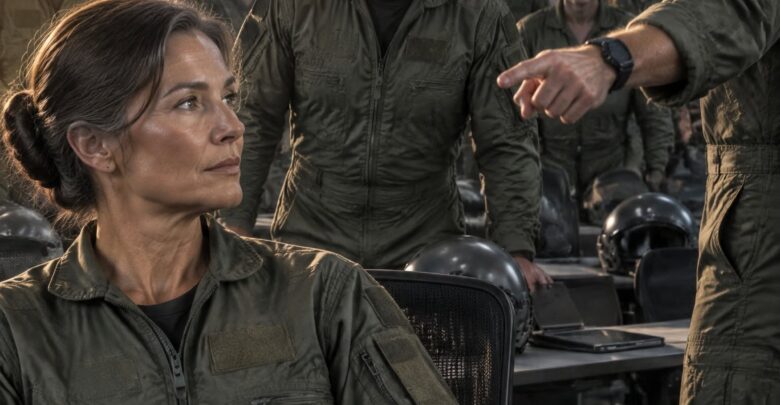
Part 1: The Woman in the Back Row
The first person I met at my new squadron asked whether my husband was one of the pilots. Staff Sergeant Lucas Ward was not insulting me; he simply saw a middle-aged woman without a name patch and assumed she belonged to someone else.
Four words could have corrected him: “Colonel Laura Bennett. Incoming DO.” Instead, I said I had arrived early and was only looking around.
I was forty-four and had flown fighters for twenty-two years. My callsign, Saint, had begun as a joke but gained weight through deployments, command assignments, and one dangerous night fourteen years earlier when my wingman, Michael Ross—callsign Papa—and I barely brought both aircraft home.
The previous year, one troubling number on a routine physical had temporarily grounded me. The Air Force reassigned me as director of operations for a fighter squadron, responsible for training, readiness, scheduling, and standards—everything except climbing into the cockpit.
On paper, it was important work. Inside, I translated it as one word: finished.
I reported three days early because arriving unnoticed felt safer than watching everyone compare the real me with the legendary Saint. As I inspected the aging notices and neglected operations board, laughter spilled from an open flight room.
A young pilot was mocking a female trainee who had struggled during a sortie. “If the jet has to be nice to you, maybe go fly a desk.”
I immediately labeled him loud, arrogant, and protected by talent. Then I caught myself. I had spent my career resenting people who judged me before knowing me, yet I had done the same to him within seconds.
In the empty ready room, I found my callsign already displayed on the schedule:
SAINT — DO / EVAL
Nobody had connected it with the unmarked woman wandering the halls. Relieved, I chose a chair in the back row.
Twenty minutes later, First Lieutenant Ryan Foster entered. Callsign Turbo. Twenty-five years old, polished, confident, and clearly the voice I had overheard.
I watched him take control of the room.
Before that briefing ended, Turbo would humiliate himself before the entire squadron.
But the more uncomfortable discovery would be mine: I was about to learn what a year of hiding had turned me into.

Part 2: The Callsign on the Board
Turbo knew how to entertain a room, but he valued laughter more than precision. He skipped one checklist item, rushed another, and interrupted a captain twice to finish jokes nobody needed.
Then he noticed me.
“Somebody’s spouse make a wrong turn?” he asked. “Or are we giving tours now?”
When I remained silent, he grinned. “What’s your callsign, little girl? Cupcake? Sunshine?”
I could have ended it by stating my rank, experience, and position. Instead, I stayed seated because invisibility had become comfortable.
“It’s on the schedule behind you.”
Turbo barely glanced at the board. Then a chair scraped violently across the floor.
Major Michael Ross stood from the second row. Fourteen years had passed since Papa and I flew together, but I recognized him immediately.
“You’ve been running your mouth at her for ten minutes,” he told Turbo. “She has more combat flight time than your entire element combined.”
Officers began checking the schedule. One by one, those who recognized Saint rose until nearly the entire room was standing.
Turbo finally read the board.
SAINT — DO / EVAL
Horror replaced his smile. “Ma’am…”
“Finish your brief, Lieutenant.”
Without his performance, his missed details became obvious. His flight lead eventually took over, and Turbo disappeared as soon as the briefing ended.
Captain Sofia Ramirez, callsign Halo, sat beside me afterward.
“You could have stopped him with one sentence. Why didn’t you?”
“Because I liked being invisible.”
She nodded. “That feels safe for a while. Then it gets cold.”
Papa confronted me next.
“You’ve always taken the hit so you wouldn’t have to take the room,” he said. “You earned every room you entered, Saint. You just stopped walking into them.”
That afternoon, I stood alone beneath my callsign and made a decision. Turbo would not lose his career for insulting me.
But he would learn who I was.
More importantly, so would I.

Part 3: The Lesson Behind the Insult
Lieutenant Colonel James Whitaker, the squadron commander, found me after lunch. Once I described what happened, he offered to remove Turbo from flight status.
I refused to punish him for humiliating me. Instead, I removed him from the next day’s sortie because he had missed two operationally significant items while performing for the room.
The following morning, I wrote SAINT across the briefing board and ran the meeting myself. When I announced that Turbo was grounded, he tried to apologize.
“This is not about yesterday,” I said. “You’re off the schedule because I cannot trust a pilot who sacrifices critical information to entertain an audience.”
I ordered him to reconstruct his failed briefing before the squadron. His confidence collapsed, but as the pilots questioned him, the humiliation became instruction.