Uncategorized
The boy laid one quarter on my counter and asked if it was enough to buy his mother five minutes of peace after a night that nearly broke her.

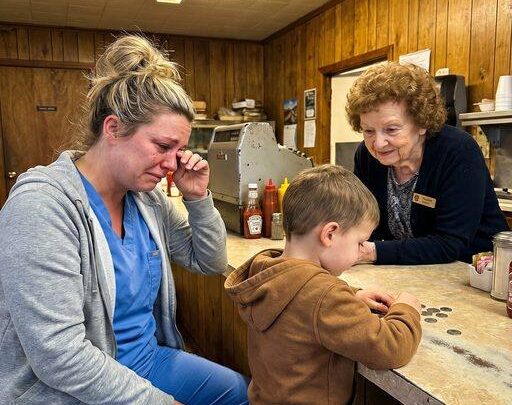
The boy laid one quarter on my counter and asked if it was enough to buy his mother five minutes of peace after a night that nearly broke her.
His voice was so soft I almost missed it over the hiss of the milk steamer.
“Can I get a coffee for my mom?” he asked. “She worked all night. She’s really tired.”
Behind him stood his mother in wrinkled scrubs, shoulders bent, eyes red, the kind of tired that looked painful. She had the face of someone who had kept too many people alive and had nothing left for herself.
She started forward fast. “Baby, no. Come on. We have to go.”
But the shame hit her before she reached him.
I knew that look.
I used to work in an office at a machine plant outside Dayton. Thirty-eight years in payroll. Same desk. Same union men. Same whistle at shift change. I thought I was safe.
Then the plant shut down in pieces. First the night crew. Then the line. Then the pension lost half its value when the market buckled and the rest got tied up in a mess nobody ever explained straight.
At sixty-three, I was wearing a visor and an apron at a coffee shop off the highway, smiling at strangers before sunrise for a wage that would have made my old self cry.
So when I looked at that quarter, I didn’t just see a coin.
I saw pride.
I saw fear.
I saw a child trying to do a grown person’s job because life had gotten too heavy too early.
I leaned down and whispered, “For today, that quarter is exactly enough.”
His eyes got wide.
I took our biggest paper cup, filled it with dark roast, snapped on a lid, and slid it toward him like it was the most normal thing in the world.
His mother covered her mouth. Tears spilled before she could stop them.
While the boy carried the cup back to her with both hands, I picked up my marker and wrote on the side:
PAID IN FULL BY LOVE.
FOR A MAMA WHO KEPT GOING.
They sat by the window for ten minutes.
She held that cup like it was warmth, sleep, mercy, and dignity all at once.
After they left, I picked the empty cup out of the trash.
I don’t know why.
Maybe because I was tired of everything kind disappearing the minute it happened.
So I pinned it to the corkboard by the register.
The next morning, Earl saw it.
Earl was one of my regulars. Retired Army. Stiff knee. Flag patch on his coat. Always drank plain coffee and always had something gruff to say about the state of the country.
He squinted at the cup.
“What’s that?”
I told him.
He grunted, drank half his coffee, and left.
Forty minutes later he came back, set a ten-dollar bill on the counter, and said, “For the next one who comes in looking like life chewed them up.”
I stared at him.
“Write that down,” he said. “Don’t make it fancy.”
So I did.
FOR THE NEXT ONE WHO LOOKS LIKE LIFE CHEWED THEM UP.
YOU MADE IT THIS FAR.
I pinned that cup beside the first one.
Two days later, Nina noticed them.
Nina was younger, always at the corner table with a laptop and a stack of notes, the kind of woman who looked busy even when she was sitting still. She and Earl never agreed on anything, though they had never once said it out loud.
She read both cups, ordered her usual tea, then said, “Add another.”
She paid for a sandwich and a drink.
“Write this,” she told me. “For a student working two jobs and still afraid to check their bank account. Your life is bigger than this hard season.”
That was how the wall began.
One cup became four.
Four became twelve.
Teachers left messages for other teachers.
A roofer left money for “the next guy whose body hurts worse than his pride.”
A widow paid for soup and wrote, “For someone eating alone today. Sit anyway. Stay.”
A man with grease on his hands took down a cup that said, “For anybody laid off after fifty. You are not done.”
The next week he came back clean-shaven in a work shirt and put one up of his own.
GOT HIRED.
PASSING IT ON.
People started coming in just to read the wall.
Not for coffee.
For proof.
Proof that somebody else had been scared too.
Proof that mercy had not completely dried up in this country.
Then came the coldest night of December.
The wind shoved the front door open and a teenage boy stepped in wearing a hoodie too thin for the weather. Snow clung to his hair. His sneakers were soaked through. He had the hard face kids get when trusting people has cost them too much.
He didn’t come to the counter.
He went straight to the wall.
He read one cup.
Then another.
Then his hand started shaking.
Finally he took down a cup near the bottom.
FOR THE KID WHO THINKS NOBODY WOULD NOTICE IF HE DISAPPEARED.
WE NOTICE.
He folded right there.
No sound.
Just collapsed inward, clutching that paper cup to his chest like it was something alive.
From the corner, Nina quietly closed her laptop.
She walked over slow, giving him space.
“You hungry?” she asked.
He nodded without looking up.
She bought him a sandwich. I brought two hot chocolates without charging either of them.
They sat for almost an hour.
She did not interrogate him.
She just stayed.
That mattered more.
Over the next few weeks, they came back.
Then again.
Then again.
He got a haircut. Then a heavier coat. Then a backpack that wasn’t split at the seams.
I heard she was helping him get connected with a caseworker and back into school. Later I heard she was applying to become his foster parent.
I looked at that wall one morning and had to grip the counter to steady myself.
Because it was no longer just cups.
It was job leads.
Ride offers.
Winter gloves.
A handwritten note from a mechanic offering free brake checks for single moms.
A churchless prayer from a man in recovery.
A stroller left by the door with a tag that said, “No trade needed. Just take it.”
Earl and Nina still sit on opposite sides of the room.
They still don’t talk much.
But last Tuesday Nina went pale at the register and started digging through her bag. No wallet.
Before I could say a word, Earl stood up.
He walked to the wall, pulled down one of his own cups, and set it beside her tea.
It read:
FOR SOMEBODY STILL CARRYING MORE THAN WE CAN SEE.
LET ME GET THIS ONE.
Nina looked at him for a long second.
Then she said, very softly, “Thank you, Earl.”
And he shrugged like it was nothing.
But it wasn’t nothing.
People keep saying this country is too angry to mend.
Maybe in some places it is.
Maybe on screens it looks that way.
But not from where I stand.
From where I stand, I see tired hands reaching for each other every single day.
I see strangers saving each other in small, stubborn ways.
I see people who have every reason to turn hard, choosing not to.
I pour coffee, yes.
But that’s not really what I do anymore.
I hand people proof that they are still seen.
And sometimes, on the worst days, that is enough to keep a soul from disappearing.