Uncategorized
On Christmas Eve, I showed up at my son’s home with a homemade turkey dish and presents for my grandchildren.

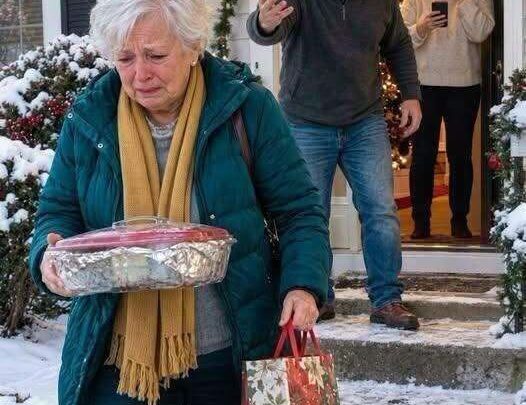
PART 2:
I stood by the kitchen window, watching the snow fall gently across my backyard.
My coffee was still hot, but my hands were trembling.
Not because I was afraid of Daniel.
Because for the first time in fourteen years, I had stopped pretending that everything between us was normal.
At 8:32 a.m., my phone rang again.
Daniel.
I let it ring.
He called a second time.
Then a third.
Finally, a text message appeared on my screen.
Mom, this isn’t funny. Whatever you’re doing with the bank, stop it right now. We have bills due today.
I read it twice.
Not once did he ask if I was all right.
Not once did he apologize for what had happened the night before.
He simply expected me to fix the problem.
I placed my phone facedown on the table.
A few minutes later, another message arrived.
The mortgage payment bounced. Claire’s parents are here, and I can’t explain what’s happening. Call me immediately.
I almost laughed at that last sentence.
For years, Daniel had called me whenever he needed something.
A few hundred dollars for an unexpected expense.
A few thousand when his business was struggling.
More money when the children needed school fees, new clothes, or activities that he said he couldn’t afford.
Every time, I’d told myself the same thing.
He’s my son. What kind of mother would I be if I refused to help?
I’d never asked him to repay me.
I’d never demanded recognition.
And I’d certainly never expected him to kneel at my feet in gratitude.
All I wanted was to remain part of his life.
Apparently, even that had been too much to ask.
At 9:05 a.m., Daniel called again.
This time, I answered.
“Mom! Finally! What on earth have you done?”
I took a slow breath.
“Good morning, Daniel. Merry Christmas.”
“Don’t do that.”
“Do what?”
“Act like everything is normal! The bank rejected the mortgage transfer. The school payment hasn’t gone through, and my business account is short. Did you cancel everything?”
“Yes,” I replied calmly.
There was silence.
Then he shouted, “You can’t do that!”
I looked at the small Christmas tree I’d decorated in my living room the previous weekend.
It was a modest tree, nothing like the enormous one in his house. But every ornament had a memory attached to it.
One was a little wooden train Daniel had made in elementary school.
Another was a paper star my grandchildren had sent me the previous Christmas.
I touched the star gently.
“Daniel,” I said, “those were my accounts. Those were my transfers. I can stop sending my money whenever I choose.”
“But you know we depend on that money!”
His words struck me harder than I expected.
Not because he was angry.
Because he had finally said the truth aloud.
He depended on my money.
But apparently, he didn’t want to depend on my love.
“You’ve been helping us for years,” he continued. “You can’t just cut us off overnight. We have responsibilities!”
“Yes, Daniel. You do.”
He stopped talking.
I continued.
“You have a mortgage, school expenses, insurance, a business, and a family. Those are your responsibilities. I’ve helped you for fourteen years because I wanted to. But I never agreed to finance a life in which I wasn’t even welcome for Christmas dinner.”
“That’s not fair!”
“Isn’t it?”
“You showed up without asking. Claire had planned everything. Her parents were here. There wasn’t enough room for everyone.”
I closed my eyes.
There it was.
The excuse.
I remembered the dining table I’d seen through the doorway. There had been empty chairs near the end, and I distinctly remembered a spare place beside the kitchen.
But even if every chair had been occupied, he could have said, “Mom, I’m sorry. We should have spoken beforehand. Let’s find another way to celebrate.”
He could have taken the food from my hands.
He could have let his children hug their grandmother.
Instead, he’d told them nobody was there.
“Daniel,” I said quietly, “if there wasn’t enough room, why did you tell your child that I was nobody?”
He didn’t answer.
“Why did you let your wife laugh at the food I’d prepared for your family?”
“She didn’t mean it like that.”
“And why did you call me later to tell me that money couldn’t buy a place at your table?”
His breathing changed.
For the first time that morning, he had nothing to say.
Then he muttered, “I was drinking. I didn’t mean it.”
“Alcohol doesn’t put words into your mouth that you’ve never thought before.”
“Mom, please. We can talk about this later. Right now, I need you to reverse the payments.”
I felt something inside me settle.
For years, I’d waited for Daniel to understand me.
Now I understood him.
Even when he was afraid of losing everything, he was still more concerned about the money than the woman who had given it to him.
“I’m not reversing anything,” I told him.
Then I ended the call.
My heart pounded so loudly that I could hear it in my ears.
I wasn’t proud of hurting him.
But I was no longer willing to hurt myself to protect him from the consequences of his own choices.
And that was only the beginning.
The Unexpected Visitor
At 10:20 a.m., someone knocked on my front door.
I wasn’t expecting anyone.
When I opened it, I found Claire standing on my porch.
She wore a cream-colored coat, dark sunglasses, and an expression I’d never seen on her before.
She looked furious.
“Margaret, we need to talk.”
I stepped aside.
“Come in if you’d like.”
She walked into the living room but didn’t remove her coat.
“I don’t know what Daniel told you, but this situation has gone too far.”
I folded my hands in front of me.
“What situation?”
“The payments. You can’t just stop paying everything without warning us.”
“I can, Claire. The money belongs to me.”
She shook her head impatiently.
“You know we have expenses. The children have school fees. We have the house. Daniel has employees.”
“I understand that.”
“Then why would you do something so cruel on Christmas morning?”
For a moment, I simply stared at her.
Cruel.
That was the word she’d chosen.
Not the word I’d used when she laughed at me the previous night.
Not the word she’d used when she watched my son shut the door in my face.
Cruel was what she called a woman who had stopped paying for a lifestyle she could no longer afford to support.
“Claire,” I said, “did you think I would continue paying your bills after what happened last night?”
She crossed her arms.
“Honestly, I thought you’d calm down.”
“Calm down?”
“Daniel said you were emotional. He said you’d probably get over it.”
I felt a coldness spread through my chest.
“So you both discussed me after I left?”
She hesitated.
“We were upset. You made the evening uncomfortable.”
“I wasn’t even inside your house.”
“That’s not the point.”
“Then tell me what the point is.”
She opened her mouth, then closed it again.
I waited.
Finally, she said, “You have to understand that we want our own family traditions. We don’t want to feel obligated to include everyone in every occasion.”
“That’s perfectly reasonable.”
She seemed surprised by my answer.
I continued.
“You’re entitled to choose who comes into your home. I’m entitled to choose where my money goes. If you want independence, you can have it. But independence means paying your own expenses, too.”
Her face reddened.
“You make it sound like we’ve been using you.”
I looked directly at her.
“I’ve paid part of your mortgage for years. I’ve covered school expenses, insurance, and business costs. I’ve sent money whenever Daniel said you were in trouble. Tell me, Claire, what would you call that?”
“We never forced you to help.”
“No. You didn’t.”
I let the silence settle between us.
“That’s what makes this so painful. I helped because I loved you. I thought I was supporting my family. I never imagined that my generosity would become something you expected while my presence became something you resented.”
Claire looked away.
For a moment, I thought she might apologize.
Instead, she said, “The children will suffer because of this.”
That hurt.
Because my grandchildren were the one part of the situation I couldn’t think about without feeling tears in my eyes.
“I don’t want the children to suffer,” I replied. “I love them more than you can imagine. I’ll continue to be their grandmother. I’ll buy them birthday presents, listen to their stories, and show up for them whenever I’m welcome. But I will not use money to purchase access to their lives.”
Claire grabbed her handbag.
“So you’re choosing money over family.”
“No,” I said softly. “I’m choosing not to confuse money with family anymore.”
She stared at me for several seconds.
Then she walked out without another word.
I closed the door behind her.
This time, I didn’t stand there wishing she’d come back.
I went to the kitchen, warmed a bowl of soup, and sat down to eat.
It was the first meal I’d enjoyed in peace in years.
The Truth About Fourteen Years
That afternoon, I went into my study and opened the old filing cabinet beside my desk.
I hadn’t looked through those records in a long time.
Inside were folders containing bank statements, school invoices, insurance documents, and notes I’d made whenever Daniel asked for help.
I began sorting through them.
The mortgage contributions alone amounted to tens of thousands of dollars over the years.
The school payments were substantial.
Then there were the insurance premiums, business loans I’d helped cover, emergency transfers, and countless smaller expenses that had never seemed important at the time.
I wasn’t interested in calculating every penny to send Daniel a bill.
I had never considered my help a loan.
But I wanted to understand the scale of what I’d been doing.
By late afternoon, I had filled several sheets of paper.
The total was far larger than I’d imagined.
It wasn’t the money itself that made me sad.
It was the realization that I’d spent fourteen years making it possible for Daniel to avoid difficult conversations about his finances.
Whenever something went wrong, I stepped in.
Whenever he overspent, I helped.
Whenever he was afraid of failing, I softened the landing.
I thought I was giving him security.
Perhaps, without realizing it, I’d also taught him that someone else would always rescue him.
I remembered his father, Robert, who had died several years earlier.
Robert used to tell me that helping someone was a beautiful thing, but helping them avoid every consequence could eventually become another kind of harm.
Back then, I’d thought he was too strict.
Daniel was our only child. I wanted to give him everything we could.
Now, sitting alone with those papers, I wondered whether Robert had understood something I hadn’t.
Love was not supposed to make one person responsible for another adult’s entire life.
And it certainly wasn’t supposed to require the person giving help to accept humiliation in return.
I placed the documents back in their folders.
I wouldn’t demand repayment.
I wouldn’t threaten Daniel with the money I’d given him.
I wouldn’t use the past to punish him.
But from that day forward, I would stop confusing rescue with love.
The Message That Changed Everything
At 6:15 p.m., my phone buzzed again.
This time, it was a message from my granddaughter, Emily.
She was twelve.
Her younger brother, Jack, was eight.
Grandma, Daddy says you’re angry with us. Did we do something wrong?
I read the message three times.
Then I sat down and typed a reply.
Oh, sweetheart, you and Jack have done absolutely nothing wrong. Grandma loves you both very much. Adults sometimes make mistakes, and those mistakes are never your responsibility. I hope you had a lovely Christmas morning. I miss you both.
A few moments later, Emily replied.
I wanted to show you my new bracelet. Daddy said you weren’t coming because you were busy.
My eyes filled with tears.
They hadn’t known I was standing outside.
They hadn’t known I had brought them presents.
They hadn’t known their grandmother had been turned away while they were celebrating inside.
I opened the bag I’d brought to Daniel’s house.
Inside were two carefully wrapped gifts.
For Emily, I’d bought a silver bracelet with a tiny heart charm.
For Jack, I’d found a wooden model airplane he’d talked about for months.
I’d chosen both gifts weeks earlier.
I held the bracelet in my palm and cried.
Not because I wanted Daniel to suffer.
Not because I wanted to win an argument.
I cried because children deserved better than being caught in the middle of their parents’ choices.
I wanted to call them immediately.
But I knew that any conversation needed to be handled carefully. I wouldn’t ask them to take sides, and I wouldn’t turn them against their parents.
Instead, I wrote one more message.
I have your presents safe here. When your parents and I work out a good time for a visit, I’ll bring them to you. Until then, remember that I love you both, always.
Emily sent back a heart.
I placed the phone against my chest.
For the first time since Christmas Eve, I allowed myself to hope.
Perhaps Daniel and I could eventually find a way forward.
But it would have to be a different relationship from the one we’d had before.
One built on honesty, not financial dependence.
One built on respect, not guilt.
And one in which my grandchildren could love their grandmother without being made responsible for the choices of adults.
Three Days Later
By the third day after Christmas, Daniel had stopped calling every hour.
He had sent several angry messages, followed by a few desperate ones.
Then, on the morning of December 28, he sent something different.
Mom, we need to talk. Can I come over?
I stared at the message for a long time.
Part of me wanted to say yes immediately.
He was my son, after all.
Despite everything, I still loved him.
But I also knew that if I rushed to make everything comfortable for him, we’d end up exactly where we’d started.
So I replied:
You can come over tomorrow at two. But I want us to have an honest conversation. I’m not discussing how to restart the payments. I’m willing to discuss what happened and what our relationship looks like from here.
He answered almost immediately.
Fine.
The following afternoon, Daniel arrived alone.
He looked exhausted.
His shirt was wrinkled, his hair uncombed, and dark circles had formed beneath his eyes.
For a moment, I saw the little boy who used to run into my arms after falling off his bicycle.
Then I remembered the man who had looked at me through a half-open door and told his own child that nobody was there.
I offered him coffee.
He accepted.
We sat across from each other at the kitchen table.
For several minutes, neither of us spoke.
Finally, Daniel rubbed his forehead.
“The bank wants to know how we’re going to cover the mortgage going forward.”
I nodded.
“That sounds stressful.”
He looked up sharply, perhaps expecting me to offer a solution.
When I didn’t, his expression hardened.
“So that’s it? You’re just going to leave us to deal with everything?”
“You’re not alone, Daniel. You have a wife, a business, and a family. You have choices to make. But those choices are yours.”
“You don’t understand how much you’ve disrupted our lives.”
I felt an ache in my chest.
“Then help me understand something. What did you think my life was like when you shut that door?”
He fell silent.
“I drove to your house carrying a meal I’d spent hours preparing. I brought presents for your children. I was looking forward to spending Christmas with my family. Instead, you treated me like a stranger.”
“Mom, I already said I was sorry.”
“No, you said you were drinking. You said Claire had planned the evening. You said there wasn’t enough room. You explained why you thought you’d done it. But you haven’t acknowledged what you did to me.”
Daniel stared at his coffee.
Then, almost under his breath, he said, “I didn’t think you’d take it so seriously.”
I felt my throat tighten.
“That’s exactly the problem.”
He looked confused.
“You didn’t think my feelings mattered enough to consider them. You assumed I’d get over it because I’ve always forgiven you. You assumed I’d keep helping because I’ve always helped. You assumed that even if you treated me badly, I’d still be there whenever you needed money.”
“That’s not true.”
“Then why was your first concern on Christmas morning the mortgage payment? Why wasn’t it an apology?”
His jaw tightened.
For several seconds, I thought he might stand up and leave.
Instead, his shoulders dropped.
“Because I panicked,” he admitted.
It was the first honest thing he’d said since arriving.
He looked down at his hands.
“I didn’t realize how much we depended on you until the payments stopped.”
I nodded slowly.
“And did you realize how much I’d been giving you before that?”
He didn’t answer.
“I wasn’t asking you to repay me with money or expensive gifts,” I continued. “I wanted to be treated like your mother. I wanted to be invited into your home. I wanted my grandchildren to know they could love me openly. I wanted to feel that I mattered even when I wasn’t paying for something.”
Daniel’s eyes grew wet.
“I’m sorry, Mom.”
This time, he didn’t follow the apology with an excuse.
He simply sat there.
And for the first time in days, I believed he might actually be listening.
The Apology I Had Waited Years to Hear
Daniel took a shaky breath.
“I was embarrassed,” he said.
“About what?”
“About the money.”
I waited.
He continued, his voice quieter now.
“Claire’s parents have always talked about being financially independent. They paid for their own house years ago. Her father built his company from nothing. Whenever we were around them, I felt like I was falling behind.”
I hadn’t known that.
“Instead of admitting we were struggling, I pretended everything was fine. I wanted them to think I had everything under control.”
“And where did I fit into that?”
He rubbed his eyes.
“You were the person who made sure things didn’t fall apart.”
“Yet I was the person you didn’t want them to see.”
He nodded.
The truth hung between us.
“I thought if you came inside that night, Claire’s parents would realize how much help we needed,” he admitted. “I didn’t want them to know.”
I felt a deep sadness settle over me.
“So you chose to humiliate me rather than risk looking unsuccessful.”
He covered his face with both hands.
“Yes.”
For a long moment, neither of us spoke.
Then he said something that surprised me.
“I think I started treating your help like it was something I was entitled to. Every time you paid for something, I told myself we’d get back on our feet soon. Then another bill came, or the business had a bad month, and I just kept accepting it. Eventually, I stopped thinking about what it cost you.”
I looked at my son.
He was no longer shouting.
He wasn’t blaming Claire or the bank.
He was finally looking at himself.
“I should never have shut that door on you,” he said. “And I should never have told Emily that nobody was there. I knew it was cruel, even when I said it.”
Tears slipped down his cheeks.
“I’m sorry, Mom. I don’t expect you to forgive me right away. But I am sorry.”
My own eyes filled.
There is a particular kind of pain that comes from being hurt by someone you love.
And there is a particular kind of relief that comes when that person finally acknowledges the hurt without trying to explain it away.
I reached across the table and took his hand.
“I love you, Daniel. I have never stopped loving you.”
He squeezed my fingers.
“But love doesn’t mean I will continue paying your expenses,” I said. “And it doesn’t mean I’ll accept being treated like an inconvenience. Those things have to change.”
“I understand.”
“I hope you do. Because I can’t go through another fourteen years like this.”
He nodded.
Then he asked, “What happens now?”
I considered the question carefully.
“Now, you and Claire make a financial plan. You work out which expenses you can afford, what needs to change, and how you’ll manage the mortgage. If the business is struggling, you look honestly at the numbers. If you need professional financial advice, you seek it.”
He listened quietly.
“And our relationship?” he asked.
“That will take time. You can call me because you want to talk to me. You can visit because you want to see me. You can invite me to dinner because you want me there. But you cannot expect money to be the price of my place in your life.”
He wiped his eyes.
“Can I still come over?”
A small smile crossed my face.
“Of course. You’re my son. My door is open to you. But the next time you come here, I hope it’s because you want to spend time with me, not because you need me to pay a bill.”
For the first time that afternoon, Daniel smiled.
It was small and uncertain.
But it was real.
Before he left, he stood beside me and wrapped his arms around me.
I held him for a long time.
I had missed my son.
Not the man who called when he needed money.
Not the man who measured every family gathering by appearances.
I had missed the son who once sat beside me in the kitchen and told me everything, even when he was afraid.
I didn’t know whether that boy was still somewhere inside the man he’d become.
But that afternoon, I saw a glimpse of him.
And it was enough to make me willing to try.
A Different Kind of Christmas
The following weeks weren’t easy.
Daniel and Claire had to make difficult decisions.
They reduced unnecessary expenses, reviewed their household budget, and met with a financial adviser to discuss their options.
Daniel also made changes to his business spending.
There were arguments. There were stressful days. There were moments when he was tempted to call me and ask me to cover another bill.
But he didn’t.
And I didn’t offer.
Not because I wanted him to struggle, but because I wanted him to learn that he could face difficult situations without expecting someone else to rescue him.
Claire sent me a message in January.
It was short.
Margaret, I owe you an apology for laughing about the food you brought on Christmas Eve. It was unkind, and you didn’t deserve it. I’m sorry.
I read it several times before replying.
Thank you for saying that, Claire. I appreciate it. I hope we can treat one another with more kindness going forward.
It wasn’t a dramatic reconciliation.
There were no tears, no long speeches, and no promises that everything would be perfect.
But it was a beginning.
In February, Daniel invited me to Sunday lunch.
I asked whether he genuinely wanted me there.
He answered, “Yes, Mom. I do. And I want you to come even if you never give us another dollar.”
I went.
When I arrived, Emily ran down the front steps and wrapped her arms around me.
“Grandma! You’re here!”
Jack followed her, nearly tripping over his own feet.
They pulled me inside and showed me their school projects, their new books, and a game they’d been playing together.
The house was noisy.
The kitchen smelled of roasted chicken.
Claire was setting plates on the table.
And Daniel stood beside the doorway, waiting for me.
For one brief moment, I remembered Christmas Eve.
The snow.
The food growing cold in my hands.
The sound of my son telling his child that nobody was there.
Then Daniel stepped forward.
“Mom,” he said, “I’m glad you came.”
He took my coat and hung it up.
There was a chair waiting for me at the table.
Not because I’d paid for it.
Not because I’d rescued them from a financial crisis.
Because I was family.
During lunch, Emily reached for my hand.
“Grandma, can you come to my school concert next month?”
“Of course, sweetheart.”
“Promise?”
I squeezed her fingers.
“Promise.”
Across the table, Daniel watched us.
He didn’t interrupt.
He didn’t make a joke about money.
He simply smiled.
And for the first time in a long while, I felt that my presence was enough.
The Final Lesson
Months later, I still thought about that Christmas Eve.
Sometimes I remembered it with sadness.
Sometimes with anger.
But more often, I remembered it as the night I finally understood something I’d spent most of my life avoiding.
A mother can love her child with her whole heart and still say no.
She can give generously without giving endlessly.
She can forgive someone without returning to the same painful arrangement.
And she can leave the door open to reconciliation without handing over the keys to her peace.
I had spent fourteen years believing that if I helped Daniel enough, I could protect him from every hardship.
I thought paying his bills was a way of showing love.
But somewhere along the way, my generosity had become an expectation, and my presence had become negotiable.
I couldn’t change the past.
I couldn’t undo the humiliation of standing in the snow with a homemade meal and presents my grandchildren never got to open that night.
But I could decide what happened next.
I could be a loving mother without being an endless source of money.
I could be a devoted grandmother without asking my grandchildren to choose sides.
And I could welcome my son back into my life without pretending he’d never hurt me.
The next Christmas Eve, Daniel and Claire invited me to dinner again.
This time, I didn’t arrive carrying a meal big enough to feed the entire household.
I brought a small box of chocolates, a few presents for the children, and a pie I’d baked that morning.
When Daniel opened the door, he stepped aside immediately.
“Come in, Mom. We’ve been waiting for you.”
I looked past him.
Emily and Jack were racing through the living room in their pajamas. Claire was arranging plates in the kitchen. Christmas music played softly in the background.
There was laughter.
There was warmth.
And there was a place for me.
Daniel took the pie from my hands.
Then he leaned down and whispered, “I’m glad you’re here. Not because of anything you’ve ever done for us. Just because you’re my mom.”
I felt tears rise in my eyes.
This time, they were happy tears.
I hugged him, walked inside, and joined my family.
The night wasn’t perfect.
The children spilled juice.
The turkey was slightly overcooked.
Daniel and Claire disagreed about which movie to watch after dinner.
But nobody pretended I wasn’t there.
Nobody made me feel that my worth depended on what I could provide.
And when we sat around the table, I realized that the best gift I’d received that year wasn’t an apology, a holiday invitation, or even the chance to hold my grandchildren again.
It was the knowledge that I could love my family without abandoning myself.
I had stopped paying for a place at the table.
And, at last, I had been welcomed to one.
Because the people who truly love you won’t measure your worth by what you give them. They’ll make room for you simply because you matter.
And sometimes, the most loving thing you can do for your family is to stop rescuing them long enough for everyone to learn what love, respect, and responsibility really mean.
THE END.