Uncategorized
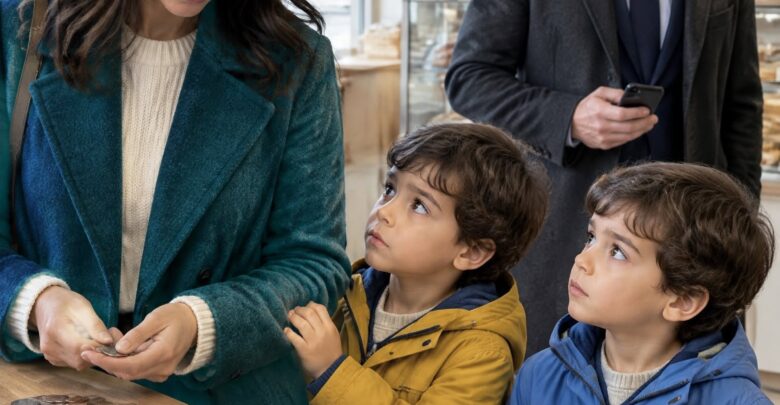
“Mom, one is enough. Eli and I can share.” I heard the little boy before I recognized his mother—my ex-wife, counting coins at a bakery counter. I hadn’t seen her in almost five years. Beside her stood identical twins, and one had the same crooked eyebrow as me. That night, she sent me a message: “Before you ask why I never told you, understand that I tried.”

PART 1: ONE SANDWICH, TWO BOYS
“Mom, one is enough. Eli and I can share.”
I heard the little boy before I saw his mother.
I had stepped into a bakery on Chicago’s South Side after touring a building my company was considering renovating. My phone was vibrating with messages about a transaction worth more than I wanted to think about that afternoon.
Then the woman at the counter turned slightly.
Naomi.
My ex-wife.
She was counting coins beside two identical little boys.
One leaned against her coat. The other held a notebook covered in planets.
“You don’t have to worry about that, Theo,” she said. “Let me check my other pocket.”
The baker reached beneath the counter.
“I made an extra turkey sandwich. Take it before I eat another lunch.”
“Frank—”
“You can help me with that school website again. We’ll call it even.”
She smiled, but her fingers stayed closed around the coins.
I hadn’t seen her in almost five years.
The last time, she had stood in our bedroom in Lake Forest while I explained why teaching science was no longer practical for the wife of a man in my position.
She had asked whether I could hear myself.
I had told her that if she couldn’t support my life, she could leave it.
Now one of the boys looked up.
He had a crooked left eyebrow.
So did I.
That proved nothing. I knew that.
Still, I forgot how to breathe.
Naomi saw me.
Her face changed before I said her name.
“Can we talk?” I asked.
She glanced at the boys.
“Not here.”
I took out a business card, then turned it over and wrote my personal number.
She accepted it without touching my hand.
That evening, I called Martin, my attorney.
“I need my old divorce file. Correspondence too. Everything Gordon handled.”
“That will take some time,” he said.
For once, I didn’t tell someone to work faster.
At nine that night, an unfamiliar number sent me the address of a coffee shop and a time.
Then a second message arrived.
“Before you ask why I never told you, understand that I tried.”

PART 2: THE ANSWER SOMEONE GAVE FOR ME
Naomi was already at the coffee shop when I arrived.
She had chosen a table near the window. A blue folder rested beside her cup.
I sat down, and for several seconds neither of us spoke.
“How old are they?”
“Four. They’ll be five in the spring.”
I looked at the folder.
“Are they mine?”
Her expression tightened.
“There wasn’t anyone else, Preston.”
“I didn’t mean—”
“I know what you meant. We can arrange whatever confirmation we need. I want this handled properly.”
The boys had been born roughly seven months after we separated.
She had discovered she was pregnant shortly after leaving.
I remembered those months differently. Meetings. Airports. My mother telling me Naomi wanted distance. Gordon telling me communication should go through the lawyers.
I had been angry enough to accept all of it.
Naomi opened the folder.
The first document was a copy of a letter.
Preston, I’m pregnant. I would like to speak with you directly before other people begin making decisions for us.
I read it twice.
“I never saw this.”
She placed a delivery receipt beside it.
My mother’s name was written in the recipient field.
“Constance was staying at the house while you were away,” Naomi said. “I sent another copy to your office.”
The next page was a response from Gordon Pierce.
It said all further correspondence should go through his office and that I did not wish to resume personal contact.
“I didn’t authorize this.”
Naomi watched me.
“That may be true. It isn’t what I was told.”
She described trying my old number, leaving messages with my assistant, and eventually speaking with my mother.
Constance had said I was moving on.
She had also said that if Naomi intended to use a pregnancy to pull me back, she should consider how a dispute with the Calloway family might end.
“She talked about lawyers,” Naomi said. “About the kind of home you could provide. About everything she thought I couldn’t.”
I felt my jaw tighten.
“She had no right.”
“I understand that now.”
“Why didn’t you—”
I stopped.
She waited.
“Go ahead,” she said. “Ask why I didn’t do more.”
I looked down at the letter.
“I’m sorry.”
Her fingers rested on the folder.
“I called again from the hospital when the boys came early. Gordon’s office told me the same thing. All communication through them. No personal contact.”
Theo had come home first.
Eli had needed longer.
Naomi told me about arranging rides, learning feeding schedules, and trying to understand medical updates while she was still recovering herself.
“I knew there were legal options,” she said. “I also knew I was exhausted, frightened, and being told you wanted me gone. I stopped trying to get a personal answer from you. Then weeks became months.”
She didn’t tell the story proudly.
She told it like someone describing decisions made with too little sleep and too much fear.
“Joanne helped,” she continued. “Frank brought food. I went back to teaching when I could. There were years when we managed better than others.”
The money from our settlement had helped at first. Reduced work, childcare, and costs connected to Eli’s care had worn it down.
“Yesterday, I’d paid for a prescription and discovered my debit card wasn’t where I thought it was,” she said. “We had food at home. We’d been out longer than I planned.”
I thought about the coins.
I had built an entire picture of her life from thirty seconds at a counter.
“I want to help.”
“The boys need support. We’ll arrange that.”
“Whatever they need.”
“And we’ll discuss how you meet them separately.”
I nodded too quickly.
“Of course. And your school—my foundation could help with the science program. A lab, equipment—”
“Don’t call my principal.”
I went quiet.
“You don’t get to enter every part of my life because you’ve finally found one part you missed.”
I leaned back.
She gathered the papers.
“I’m not asking you to prove you have money. I already know that.”
Before she left, I said my mother had taken years from us.
Naomi looked at me for a long moment.
“Your mother’s story worked because you had already taught me what to expect from you.”
That afternoon, I remembered more than our final argument.
I remembered missing her students’ science exhibition because a dinner invitation had seemed more useful.
I remembered telling her that nobody needed to hear about her classroom at a fundraiser.
I remembered how often she had begun a sentence and then decided not to finish it.
My mother had kept information from me.
I had given Naomi reasons to believe I didn’t want it.

PART 3: THE MAN IN THE OLD PICTURE
Confirmation came through the process Naomi and I arranged together.
Theo and Eli were my sons.
I read the results alone in my office.
Then I called Naomi.
“I’ve seen them,” she said before I could speak.
“What happens now?”
“We do this carefully.”
We spoke with a family professional about introducing me. Naomi wanted the boys to receive a simple, truthful explanation before I appeared in their living room.
I wanted to arrive with everything they had ever wanted.
She asked me to arrive with myself.
Two weeks later, I stood outside her apartment at the agreed time with a packet of plain paper in my hand.
It was the only thing she had suggested I bring.
Theo opened the door with Naomi standing behind him.
“You’re Preston.”
“I am.”
“Mom said you’re our dad.”
My throat tightened.
“Yes.”
He considered that.
“Can you make airplanes?”
I looked at the paper.
“I can try.”
The apartment was bright, crowded with books, and unmistakably lived in. A half-finished puzzle occupied one end of the table. Two coats hung from hooks low enough for children to reach.
Eli stood beside a bookshelf, holding the notebook I had seen at the bakery.
I crouched a few feet away.
“Hi, Eli.”
He looked at me, then at Naomi.
She nodded.
He went to the shelf and returned with a photograph.
Our wedding.
Naomi and I were standing outside a little church in Galena. I was looking at her as though I understood what I had been given.
Eli held the photograph beside my face.
“You’re this man.”
“Yes.”
“Why aren’t you in our new pictures?”
Theo stopped pulling at the paper wrapper.
I looked at both boys.
Naomi and I had prepared for questions.
Preparation did not make the question hurt less.
“I didn’t know about you for a long time,” I said. “And before that, I made mistakes with your mom. I wasn’t there when I should have been. None of that was because of anything you or your brother did.”
Eli studied me.
“Mom has lots of pictures.”
“I’d like to see them sometime.”
“You have to ask her.”
“I will.”
We spent the next hour making airplanes.
Mine flew into the refrigerator.
Theo laughed so hard he had to sit down.
Eli inspected my folds, then quietly corrected one wing.
When it was time to leave, Theo wanted another plane. Eli wanted to know when I was coming back.
“Saturday at ten, if that still works for everyone.”
I looked at Naomi.
She nodded.
“For how long?” Eli asked.
“Until lunchtime.”
He repeated it under his breath.
Later, while Joanne took the boys downstairs to look at a neighbor’s new puppy, Naomi opened the blue folder again.
This time, she showed me photographs.
Two impossibly small babies.
Naomi asleep in a hospital chair.
Theo with a knitted hat slipping over one eye.
Eli gripping a finger that belonged to Frank.
“He closed the bakery early that day,” she said.
I stared at the photograph.
Frank had known how small my son’s hand was.
I had never thought to wonder.
There were birthday pictures too. Joanne holding a cake while Naomi tried to keep both boys from reaching the candles. A summer afternoon at the lake. A cardboard rocket.
They had been loved.
That mattered.
It also meant I couldn’t pretend their lives had been waiting for mine to begin.
“Could I have copies of a few?” I asked.
Naomi chose several and said she would send them.
During those weeks, our attorneys helped arrange financial responsibilities, including the boys’ current needs and the expenses Naomi had carried. I provided the information requested and stopped treating each transfer as something that deserved acknowledgment.
The money arrived whether a visit went well or not.
Naomi continued teaching.
Nobody called her principal.
By my third Saturday, Theo had decided I was useful for reaching things.
Eli still asked how long I would stay.
One Friday evening, Naomi called so the boys could tell me what supplies they wanted for a cardboard space station.
Theo requested tape.
Eli requested blue paper.
Then he leaned close enough to the phone that I could hear him breathing.
“You’re coming tomorrow?”
“Ten o’clock.”
“I already put your chair by the table.”
I sat still for a moment after the call ended.
Then I entered the visit in my calendar again, even though it was already there.
PART 4: THE EMPTY CHAIR
Martin’s review of the old files took time.
The records showed that my mother had received correspondence. They showed that Gordon’s office had responded to Naomi under the authority of representing me.
They also raised questions about what had been withheld, who had given instructions, and what I had been told.
I asked for an independent review of those questions.
Then I went to see my mother.
Constance was in the sitting room where Naomi had once spent an entire dinner answering questions about why she still worked.
I put copies of the correspondence on the table.
“Did you know?”
She didn’t touch the papers.
“I knew she claimed to be pregnant.”
“And when she called after they were born?”
My mother looked toward the window.
“You were finally focused. You had spent months recovering from that marriage.”
“She was in a hospital with two premature babies.”
“You don’t know what she would have demanded.”
I stared at her.
She still spoke about Naomi as though she were a negotiation that had gone badly.
“You had no right to answer for me.”
“I protected you.”
“You kept me from making a decision about my own children.”
She began to say that Gordon had handled the details.
I stopped her.
“His role is being reviewed too.”
I told her she would no longer receive private correspondence on my behalf. I also told her not to contact Naomi or approach the boys.
Any future contact with them would require careful discussion with their mother.
Constance did not cry.
She said I was being manipulated again.
I left before I began shouting.
For the next several weeks, I kept my Saturday appointments.
I learned that Theo hated pieces of tomato but would eat tomato sauce. Eli wanted the names of things to be correct, including moons I had never heard of.
I learned where the clean cups belonged.
I learned that Naomi saying a visit had gone well did not mean she wanted to discuss our marriage.
And gradually, dangerously, I began to think I had figured it out.
The mistake happened on a Saturday in November.
A financing call had been scheduled for eight. I believed that left plenty of time.
At nine-fifteen, an issue surfaced.
At nine-thirty, I told myself we were almost finished.
At nine-forty-five, I should have been on the road.
Instead, I stayed.
I sent Naomi a message at ten-oh-four.
Running late. Leaving shortly.
She answered:
We have plans at eleven. Please tell me when you’re actually on your way.
I read that as irritation.
I should have read it as information.
By the time I reached her building, it was ten-forty.
She and the boys had left a few minutes earlier.
I sat in the car with the engine off.
On my phone, I opened a page for a children’s telescope.
Eli had mentioned wanting to see the moon.
I selected the best one.
Then Naomi called.
“They’re with Joanne,” she said. “I can talk for a minute.”
“I’m sorry. The meeting ran over.”
“You let it run over.”
I looked at the telescope on the screen.
“I know.”
“Do you?”
She wasn’t shouting.
That made it harder to hide behind my own embarrassment.
“You were forty minutes late. Eli spent those forty minutes asking whether he had done something wrong.”
I closed my eyes.
“What?”
“He thought you didn’t want to build with him because last time he told you your moon was too small.”
I remembered him correcting the paper circle I had cut.
I had laughed.
He had remembered.
“Naomi, I would never—”
“Then make your actions easier for a four-year-old to understand.”
I deleted the telescope from the cart.
The next afternoon, at a time Naomi agreed to, I apologized to the boys.
“I said I would be there at ten. I wasn’t. I stayed at work too long, and I didn’t tell your mom early enough.”
Theo asked whether we could still make the space station another day.
“Yes. We can plan that.”
Eli looked at the carpet.
“Was my moon wrong?”
I swallowed.
“No, buddy. Your moon wasn’t the problem. I made the mistake.”
He nodded, but he didn’t hug me.
I did not ask him to.
On Monday, I changed my calendar.
I blocked travel time around visits. I stopped accepting calls that depended on everything going perfectly for me to leave on time.
I spoke with Russell, my business partner, about decisions that did not need to wait for me.
Then I asked my assistant to flag conflicts before accepting changes, instead of assuming personal appointments could always move.
None of it was difficult in the way I had claimed for years.
It required me to let other people do their jobs and accept that I could not be in every room.
Several weeks later, the boys invited me to their preschool’s family science morning.
Eli had made a model of the solar system.
“It starts at nine,” he told me.
“I’ll be there.”
The afternoon before the event, Russell called.
The other side of an important transaction wanted to move our final discussion to nine the next morning.
For a moment, I pictured the classroom.
Then I pictured the chair Eli had once put beside the table.
I opened the agenda.
This time, I made the arrangements before anyone had to wait.
PART 5: THE PICTURE WITH ROOM FOR ME
Russell and I worked through the questions that evening.
He could lead most of the discussion. Two decisions required my approval, and I addressed them in writing with the team before the call.
For anything unexpected, we arranged a follow-up later in the day.
“You’ll miss the opening,” he said.
“I know.”
“All right. Send me your notes.”
That was the conversation.
No ultimatum.
No abandoned company.
Just a plan that should not have taken me so many years to learn how to make.
At eight-forty the next morning, I parked near the school.
I checked in, found the classroom, and sat on a chair so small my knees nearly reached my chest.
Naomi was helping Theo reattach a paper wing to a cardboard airplane.
She saw me and nodded.
Eli stood beside his solar system, looking toward the door.
When he found me, his shoulders dropped slightly.
Then he turned back to his model.
He explained that Saturn’s rings were made from part of a paper plate.
Theo interrupted to announce that his airplane could fly if nobody touched it wrong.
I listened to both presentations.
I asked questions.
I got glue on my sleeve.
When the teacher asked for help stacking chairs afterward, I stayed.
That morning did not repair the Saturday I had missed.
It became one of the mornings I hadn’t.
There were more.
A dentist appointment.
A rainy afternoon when the boys argued over the same red marker despite owning two boxes of markers.
A winter evening when I learned that packing pajamas meant packing the particular pajamas Eli expected, not whichever ones I found first.
As our arrangements developed, I took on more of their ordinary care.
I learned their schedules well enough that Naomi did not have to remind me of everything.
When I needed to travel, we discussed it ahead of time. I called when I said I would. If a plan changed, I helped make a new one before the boys were left wondering.
Naomi’s life changed too.
With dependable financial support and more shared responsibility, she had room to make decisions that had been crowded out by urgency.
She kept teaching science.
She enrolled in a professional course she had postponed.
She chose a more convenient apartment when her lease ended.
I helped carry boxes because she asked.
I did not suggest that my house would solve everything.
Our conversations grew easier, but they did not become a promise that our marriage would return.
Once, while the boys were washing paint from their hands, I apologized for the things I had said about her work.
She kept folding a towel.
“I loved teaching when you met me,” she said.
“I know.”
“You acted like it was something I was supposed to outgrow.”
“I was wrong.”
She looked at me.
“Yes. You were.”
I let that be the end of the conversation.
Nearly a year after the afternoon at the bakery, the four of us went back together.
By then, Theo had started calling me Dad without announcing the change. Eli used both Dad and Preston, depending on what he was thinking about.
Frank looked up from the counter.
“My favorite scientists.”
“I made a volcano,” Theo said.
“In a tray,” Naomi added quickly.
Frank nodded.
“Important distinction.”
We ordered sandwiches.
Four of them.
When I reached for my wallet, Frank rang up every item.
“You’re paying full price,” he told me.
“I expected to.”
He gave me a small nod, then asked Naomi about a student whose science project he had helped supply with empty jars.
They talked easily.
I listened.
He belonged in their story long before I did.
At the table, Theo asked whether we could take a picture.
I glanced at Naomi.
“Of all of us?” she asked him.
“Yes. Frank can do it.”
Frank wiped his hands and took her phone.
Theo stood beside Naomi. Eli moved close to my chair, still holding his notebook.
I didn’t pull anyone closer or ask for another arrangement.
Frank took two pictures because Theo made a face in the first.
Naomi looked at them and laughed.
“Actually, I like that one.”
After lunch, we stepped outside.
There was a bench beside the bakery window. I sat to zip my coat while Naomi finished putting her phone away.
Theo spotted a model train running through the display in the shop next door.
“Mom! It has a tunnel!”
She walked over with him.
Eli started to follow, then stopped beside me.
“Hold this, Dad.”
He placed his planet notebook on the bench.
“Of course.”
He ran the few steps to his brother.
For months, he had looked back whenever he moved away from me. At playgrounds, in classrooms, even across Naomi’s living room.
That afternoon, he pressed his hands to the shop window and watched the train disappear into the tunnel.
He didn’t turn around.
I rested my hand on his notebook and stayed where he had left me.