Uncategorized
I Paid $2,100 a Month Toward Daddy’s Nursing Home for Three Years, Then I Found the $26,000 Rent My Sister Never Mentioned

The form was sitting right on top of the stack.
It was a thin white sheet with Bobby Whitt’s name typed in the upper corner and my father’s name typed underneath it. Halfway down, in a little box, was one word and one number.
Rents. $26,000.
I read it sitting in my car in the gravel lot behind the tax preparer’s office, with the engine off and the manila folder propped open against the steering wheel. My sister Sherry had asked me to drop Daddy’s tax papers off for her that morning because her husband, Roger, had a follow-up with his heart doctor.
Underneath that form was Daddy’s bank statement from Farmers National Bank. December.
I’m a retired postmaster. I spent thirty-one years making numbers match. I knew in about four seconds that these didn’t.
His Social Security went in on the third. His long-term care policy paid on the tenth. The nursing home drew its money out on the fifteenth. That was it. There was nothing else in that account.
Not in December. Not in any month before it.
No rent. Not $13,000 in March. Not $13,000 in November. Not one single dollar from the 200 acres my father had worked since he was a boy.
I flipped back to the form. Then back to the statement. Then back to the form again, like the numbers might rearrange themselves if I gave them enough chances.
They didn’t.
I sat there for an hour. Cars came and went from the lot. A man in a feed cap went in with a shoebox full of receipts and came out without it. I didn’t move.
Because for three years, I had been paying $2,100 a month toward my daddy’s bill at the nursing home.
The bill was $7,400 a month. His Social Security and his old long-term care policy covered $5,300 of it. The rest came out of my retirement. Every month. On the first.
Thirty-six months. I didn’t have to get out a calculator for that one. I knew the number the way you know your own phone number.
$75,600.
I’d done it because my sister told me Daddy’s money was gone.
She told me the week he went in. We were standing in the hallway outside his room, and she was holding her purse in front of her with both hands like a shield.
“The savings all went on the hospital and the rehab,” she said. “And Bobby’s quit the crop ground, Teresa. He’s just running cattle out there now for keeping the fences up. There’s nothing coming in but Daddy’s checks.”
I believed her.
Why would I not believe her? She was my big sister. She had Daddy’s power of attorney, because she lived eleven miles from him and I lived forty, and because she’d always been the one who handled the paperwork in our family. She’d had a lawyer in town draw up a durable power of attorney the week after Daddy’s fall. Daddy signed it in his hospital bed with the pain medicine still in him.
I went home that night and sat down with my husband, Doug, at our kitchen table.
Ezoic
Doug drove a road grader for the county highway department for twenty-eight years. He doesn’t waste words, and he didn’t waste any that night.
“We’ll pay it,” he said. “Your daddy fed half this county one way or another. We’re not going to let him sit in that home worrying about money.”
He was right that Daddy couldn’t have gotten on Medicaid anyway, not with 200 acres in his name. And Daddy would have died before he sold that land.
So we paid it.
The next morning, I called the man who handles our retirement account at the Edward Jones office in town and set up a monthly withdrawal from my IRA. $2,100 on the first of every month, deposited into our checking, then straight out again to the nursing home.
“That’s a pretty big draw for your age, Teresa,” he said carefully. “You sure about this?”
“It’s my daddy,” I said.
He didn’t ask again.
We put off the new roof on our house. The shingles over the back bedroom had been curling for two years, and we’d been saving for it, $11,000, the estimate was. We set out pans when it rained hard.
We stopped talking about the trip to see the Smoky Mountains. Doug and I had been talking about that trip for twenty years. We used to lie in bed and plan it. Which cabin. Which overlooks. Which pancake house.
We just stopped talking about it.
And I never once complained to Sherry. I never once asked her to show me a statement.
That was my mistake, and I own it. I trusted a piece of paper I’d never seen, because the person holding it was my sister.
Now I’d seen the paper. It was sitting on my steering wheel. And it said Bobby Whitt had paid my father $26,000 in rent last year.
Bobby Whitt was not a man who sent a form to the government unless the money had actually changed hands.
I didn’t call Sherry.
I want to say that plainly, because I’ve thought about it a hundred times since. I had my phone in my hand. Her name was right there on the screen. My thumb was right over it.
But a phone call would only have given her a day to build a story. And Sherry was always good with a story.
More than that, it wasn’t my money to fight over. It wasn’t even my bill, not really. It was Daddy’s land. Daddy’s rent. Daddy’s life.
And my father, whatever else had happened to him, could still talk.
I went inside and handed the folder to the preparer, a nice young woman with reading glasses on a beaded chain. I didn’t say a word about the form. I just smiled and said thank you.
Then I drove the forty miles home with the radio off.
My daddy is Clayton Akers. He’s 84 years old. He raised burley tobacco and black cattle on the same rolling ground in south-central Kentucky that his own daddy raised them on. He was still cutting tobacco by hand into his seventies, sweating through his shirt in August with a tobacco knife and a spear.
Three years ago, he fell in the barn lot and broke his hip.
They pinned it at the hospital in Bowling Green. He did the rehab and worked hard at it, harder than the therapists had ever seen an 81-year-old work. But his legs never came back the way they were. He couldn’t get from the bed to the bathroom by himself anymore.
That’s when he went into the nursing home in town.
His mind never left him for a single day. He reads the county paper front to back every morning. He can tell you what corn brought at the elevator in 1974. The aides call him Mister Clayton and come to his room to settle their arguments about ball scores.
That’s what made it so hard to understand.
Sherry hadn’t taken money from a man who wouldn’t know. She’d taken it from a man who would know the very minute anybody told him.
Nobody had told him.
That night, I laid the form on our kitchen table in front of Doug. He read it twice, the way he reads anything that matters, with one finger moving under every line.
“Well,” he said finally. He set the paper down and pushed it back across the table toward me. “What are you going to do?”
“I’m going to take Daddy for a drive,” I said.
Doug looked at me for a long moment. Then he nodded slowly.
“You want me along?”
I thought about it. Doug is a good man, and Daddy likes him. But I knew my father. I knew this was going to be a hard day for him. And I knew he wouldn’t want an audience for it, not even a kind one.
“No,” I said. “I want it to be just him. Him and his land. He doesn’t need a crowd. He needs to sit on his own ground and ask his own question.”
On Sunday morning, I drove to the nursing home early, before the church crowd came through.
Daddy was sitting up in his recliner by the window, already dressed, reading the paper with his glasses down on the end of his nose.
“You’re early,” he said without looking up. “Did the preacher die?”
“Not that I heard.”
I kissed him on top of the head. His white hair was combed flat with water, the way he’s combed it every morning of his life.
“I want to show you something, Daddy,” I said. “And then I want to ask you something.”
I pulled the other chair close and sat down. I put the form in his hands.
I didn’t explain it. Daddy filed farm taxes for sixty years. He knew what that sheet of paper was better than I did.
He read it once.
Then he took his glasses off. He wiped them slowly on the front of his shirt. He put them back on. And he read it again.
His mouth got thin.
“Sherry told me Bobby’s rent goes on my bill here,” he said slowly. “She told me the rent and my checks cover it. With a little left over for the taxes on the place.”
I hadn’t known that. I hadn’t known she’d told him anything at all.
I had to sit very still for a minute before I could answer him.
“Daddy,” I said. “I’ve been paying your bill. Twenty-one hundred dollars a month. Sherry told me your money was gone.”
He looked at me then.
I will never forget that look as long as I live. It wasn’t anger. Not yet. It was the look of a man who walks out to the barn at daylight and finds the door standing wide open and every stall empty.
“How long?” he said.
“Since you came in here. Three years.”
He set the form down on the arm of his recliner. He laid his hand flat on top of it. Those big old knuckles, all swollen up from arthritis, the skin spotted from eighty summers in the sun.
He sat that way a long time, looking out the window at the parking lot.
“Why didn’t you call your sister?” he said finally.
It wasn’t a question so much as him checking my thinking. That was always Daddy’s way. When I was a girl and I’d come to him with a problem, he’d never tell me what to do. He’d just ask why I did what I did, and make me hear myself say it.
“Because it’s not my money,” I said. “It’s yours. And because I figured you might like to ask somebody about it yourself.”
He was quiet another moment.
Then he said, “Get my hat.”
I reached for Daddy’s old brown hat hanging beside the door.
He put it on slowly, adjusted the brim, and looked at me.
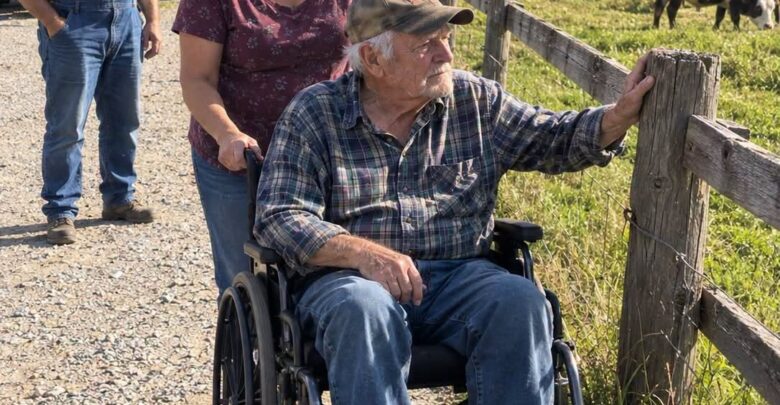
“Take me out to the farm, Teresa.”
I helped him into his wheelchair and drove him down the familiar country roads. When we reached the farm, Bobby Whitt’s truck was parked beside the equipment shed.
Bobby came walking toward us as soon as he recognized Daddy.
“Mister Clayton! Didn’t know you were coming out today.”
Daddy nodded.
“Bobby, I need to ask you something. Have you been paying rent on my land?”
Bobby looked surprised.
“Of course I have. Thirteen thousand in the spring and thirteen thousand in the fall. Just like we’ve always done.”
“And who have you been paying?”
“Sherry. She said she was handling your accounts.”
Daddy looked toward the fields.
“Did she ever tell you the money was going toward my nursing home?”
Bobby shook his head.
“No, sir. I figured that was between you and your daughter.”
Daddy thanked him and asked if he could provide copies of the payment records.
Bobby agreed immediately.
On the drive back, Daddy didn’t say much. He watched the fields pass through the window, his hands resting on his knees.
Finally, he spoke.
“Teresa, I trusted your sister to handle my money. But I never told her to take yours.”
“I know, Daddy.”
He turned toward me.
“Seventy-five thousand, six hundred dollars?”
I nodded.
His eyes filled with tears.
“You and Doug gave up things you needed because you thought I couldn’t pay my own way.”
“We wanted you taken care of.”
He reached over and squeezed my hand.
“And now I’m going to make sure you’re taken care of, too.”
The next morning, Daddy asked me to arrange a meeting with an attorney who had never represented Sherry.
We brought the tax form, the bank statements, and Bobby’s payment records.
The attorney explained that the documents raised serious questions about how Daddy’s money had been managed. He also told us that the power of attorney didn’t give Sherry permission to use Daddy’s funds for herself.
With Daddy’s approval, we requested a complete accounting of the money she had handled.
Three days later, Sherry called me.
“Teresa, what have you done?”
“I haven’t done anything to you, Sherry. Daddy asked to see his financial records.”
“You went behind my back!”
“No,” I said quietly. “You went behind his.”
She hung up.
The following Friday, we met in the attorney’s office.
Sherry arrived with Roger. She looked tired, and for once, she didn’t have a prepared explanation.
Daddy sat across from her with his hat resting on his lap.
“Sherry,” he said, “where’s my rent money?”
She stared at the table.
“I used some of it for expenses.”
“What expenses?”
She began crying.
Roger looked at her.
“Tell him.”
Finally, Sherry admitted that she had deposited the farm rent into an account she controlled. Some of the money had gone toward their own household bills, Roger’s medical expenses, and credit card payments.
She had told Daddy the rent was covering his nursing home expenses while telling me there was no rent coming in.
Daddy listened without interrupting.
When she finished, he asked one question.
“Why didn’t you just tell us you needed help?”
Sherry covered her face.
“Because I was ashamed.”
Daddy’s voice was quiet.
“So you let your sister spend her retirement instead?”
Nobody answered.
The attorney helped Daddy revoke Sherry’s financial authority and arrange for an independent person to manage his accounts. A review of the records established how much rent had been diverted, and Sherry agreed to a formal repayment plan.
Daddy also arranged to reimburse Doug and me for the $75,600 we had paid toward his care, using his available funds and future farm income.
I tried to refuse.
He wouldn’t hear it.
“Teresa, you helped me because you loved me. I’m paying you back because that money should never have been yours to spend.”
Six weeks later, Doug and I finally called the roofing company.
The new shingles went on before the first winter storm.
And that spring, we took our trip to the Smoky Mountains.
We rented a little cabin with a porch overlooking the hills. Doug sat outside every morning with his coffee, watching the mist rise between the trees.
One evening, he looked over at me.
“You know what the best part is?”
“The view?”
He shook his head.
“Knowing we can sit here without worrying about the next nursing home bill.”
I laughed, but my eyes filled with tears.
Sherry and I didn’t become close again overnight. Daddy still loved her, but he made it clear that forgiveness and trust were two different things.
She began making her repayments, and over time, she started visiting him without bringing up money.
As for Daddy, he continued reading his newspaper every morning and asking about the farm.
One Sunday, I found him sitting by the window, his old brown hat on the table beside him.
“Teresa,” he said, “you remember what I told you when you were little?”
“Which part, Daddy?”
“That land can grow tobacco, corn, and cattle. But it can’t grow honesty. That’s something a person has to bring with them.”
I smiled.
He reached for my hand.
“You brought it.”
I squeezed his fingers.
For three years, I had believed that helping my father meant quietly sacrificing whatever was necessary.
But I learned that love shouldn’t require one person to carry a burden built on somebody else’s lies.
The missing $26,000 had led us to the truth.
The $75,600 had eventually come back to us.
But what mattered most was that Daddy had regained control of his own life, and I could finally look at my sister without pretending nothing had happened.
Sometimes the smallest piece of paper can reveal the biggest betrayal.
And sometimes all it takes to begin setting things right is an eighty-four-year-old farmer putting on his hat and deciding it’s time to ask a question.
THE END.