Uncategorized
I let my mother and stepfather live in the cabin my dad left me because they needed somewhere to go. Three years later, they tried to sell it without asking. I thought my mother had been pressured into staying quiet—until my lawyer showed me an email she’d sent nine days before I found out. I read the first sentence twice. Then I picked up my phone and asked her one question.

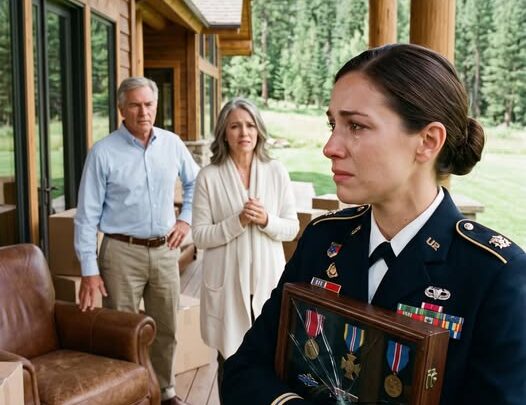
PART 1 — THE SIGNATURE
My stepfather called at 5:42 on a Tuesday morning to tell me he had sold my father’s cabin.
I was in temporary quarters at Fort Bliss, Texas, putting on my running shoes.
“Before you hear it from somebody else,” Victor said, “we finally got that place sold.”
For a moment, I watched the loose end of my shoelace swing between my fingers.
“What place?”
He sighed.
“The cabin, Elena. Don’t make this difficult.”
My father had built that cabin outside a small mountain town in Colorado. He had laid the kitchen floor himself. One board near the refrigerator still carried a shallow crescent where I had dropped his hammer when I was eleven.
“What do you mean, sold?”
“We accepted an offer. Enough to clear some things up. Your mother can finally stop worrying about bills.”
He paused, then added:
“And Brianna’s getting her birthday trip. Thirty only comes once.”
His daughter had posted photographs of a resort in Maui three days earlier.
Oceanfront room. Private balcony.
I had liked the post.
“When do the buyers get the keys?” I asked.
“Friday. See? I knew you’d be reasonable once you thought about it.”
Friday.
It was Tuesday.
I put my foot on the floor.
“Victor, I own that property.”
“Your mother has lived there for years.”
“That wasn’t my question.”
“You haven’t asked a question.”
He sounded pleased with himself.
Behind him, I heard my mother say something I couldn’t make out.
Then she took the phone.
“Honey, we need a fresh start.”
“Did you sign something?”
“Please don’t turn this into an interrogation.”
I was thirty-two years old, an Army intelligence officer, and my mother could still make me feel twelve by saying please in that exhausted voice.
I asked her to send me everything they had signed.
Victor came back on the line.
“We’ve already cleared out most of your dad’s old stuff. You should’ve taken it if it mattered that much.”
He hung up before I could answer.
The online listing took less than a minute to find.
There was my father’s porch.
His kitchen.
The window beside the stone fireplace where he used to read.
But his brown chair was gone.
Above the mantel, a pale rectangle marked the place where his military medals had hung.
I called Sloane Mercer, the Colorado attorney who had helped me organize the property records several years earlier. Her office wasn’t open yet. I left a message, then sent an email from my personal account.
Subject line: I have not authorized a sale.
By midmorning, she called.
“There is a pending transaction,” she said. “It has not closed. I’m contacting the title company.”
“How did they even get this far?”
“Someone submitted paperwork claiming Victor can act on your behalf.”
An hour later, a document arrived through her secure portal.
A power of attorney.
My name appeared at the top.
At the bottom was a signature that looked enough like mine to make my stomach tighten.
I enlarged it.
Then enlarged it again.
I had never seen that document before.
“Elena?” Sloane asked over the phone.
I realized I had stopped answering her.
“I didn’t sign it.”
Her voice became very quiet.
“Then that is where we start.”

PART 2 — THE DAUGHTER WHO WAS SUPPOSED TO UNDERSTAND
My father, August Calder, believed a person should know how to repair a loose board.
“Even if you end up hiring somebody,” he told me, “you ought to know what you’re asking them to fix.”
When I was thirteen, we spent a whole Saturday replacing two porch boards at the cabin.
I wanted to rush.
He made me measure again.
By lunchtime, I was furious with him.
By dinner, I had walked across those boards at least twenty times, pretending I needed something from outside.
He never teased me about it.
He just watched from his chair with that small smile fathers wear when they’re trying not to embarrass their daughters.
He died when I was sixteen.
For months afterward, I called his phone to hear the voicemail greeting.
My mother remarried the following year.
Victor arrived with a loud laugh, unpaid obligations he called temporary setbacks, and a daughter two years younger than me.
Brianna wasn’t cruel at first.
She was sixteen. She liked expensive things. Her father had taught her that wanting something was usually the beginning of getting it.
I had learned to ask whether we could afford it.
That difference followed us into adulthood.
When my acceptance to West Point arrived, Victor glanced at the packet and said:
“Four years of being yelled at. Could’ve stayed home and gotten that for free.”
Brianna laughed.
My mother touched my arm.
“He’s joking. Don’t spoil dinner.”
Later that evening, Abel Kincaid pulled into the driveway carrying a grocery-store cake.
Everybody called him Bear. He and my father had served together years before, and he had remained the kind of friend who showed up when there was actual work to do.
The cake had crooked blue lettering.
PROUD OF YOU, ELENA.
“Lady at the bakery ran out of room,” he said. “I told her that was the important part.”
He stayed while I opened every page of the acceptance packet.
He asked questions.
He listened to the answers.
My father had left the cabin to me, with the estate arrangements handled while I was still a minor. By the time I was an adult, the ownership records were settled.
Years later, after another of Victor’s business ventures collapsed, my mother called crying.
They needed somewhere to live.
Just until they got back on their feet.
I said yes.
Sloane helped me put the arrangement in writing. Mom and Victor could occupy the cabin under specified conditions. I would continue covering certain ownership expenses. They would handle utilities and ordinary upkeep.
They could not sell it.
They could not borrow against it.
My mother signed.
Victor complained about the paperwork, then signed too.
Temporary became three years.
Whenever I asked about their plans, Mom said:
“You know how hard he’s trying.”
I knew how often I paid for something after hearing that sentence.
Now, sitting at a small desk in Texas, I sent the title company a written statement denying that I had signed the power of attorney or authorized a sale.
Sloane sent the occupancy agreement and the ownership records.
The company confirmed that closing would not proceed while the authority documents were disputed.
Victor called eleven times that afternoon.
On the twelfth, I answered.
“You’ve embarrassed us,” he said.
“I stopped a sale I never agreed to.”
“There are buyers involved. A deposit. People have made plans.”
“So have I.”
“You don’t even live here.”
I looked at the photograph I kept beside my laptop: Dad and me on the porch, both squinting into the sun.
“That doesn’t make it yours.”
That evening, Brianna posted online.
No names at first.
Just a paragraph about people who promised to help family, then changed their minds when everyone was counting on them.
Below it, someone asked what had happened.
Brianna replied:
My stepsister agreed to sell a family property. Now she’s backing out and hurting everyone.
My mother added a comment.
This should be handled privately, as a family.
I read those two sentences several times.
Until then, I had still imagined Mom hearing about the sale too late. Victor taking charge. Mom getting frightened and going along because she didn’t know what else to do.
But she had just watched her daughter tell a lie about me in public.
And her only objection was where we discussed it.

PART 3 — WHAT MY MOTHER HAD SAID
Sloane advised me to keep my messages brief and preserve everything.
So I stopped arguing over the phone.
I saved the listing, the posts, the texts.
I submitted a leave request through my chain of command and explained that I had an urgent property matter involving suspected misuse of my identity.
While I waited for approval, I called Bear.
He lived forty minutes from the cabin.
“I need to know what happened to Dad’s things.”
He didn’t tell me to calm down.
He asked what he could do.
I gave him written permission to collect my father’s belongings if Mom and Victor allowed him access. Sloane separately requested that nothing else be removed or discarded.
My mother agreed to let him come by.
Two hours later, Bear sent a photograph.
My father’s chair stood in the shed beneath an old plastic drop cloth.
Beside it were four cardboard boxes.
The medal display lay face down on top of one.
Its glass was broken.
I called immediately.
“Are they still in it?”
“Every one I can see.”
“And his letters?”
“There’s a metal file box. I haven’t opened it.”
In the background, Victor said:
“We weren’t throwing it away. We were making room.”
Bear waited until he was back in his truck before speaking again.
“Your mom said a clearance service was coming Thursday.”
I pressed my hand over my mouth.
“I’ve got what they released to me,” he said. “It’s dry. It’s safe. We’ll sort it when you get here.”
My leave was approved that afternoon.
I flew to Colorado the next morning.
Bear met me at the airport wearing the same canvas jacket he had owned for at least fifteen years.
He took my bag.
For a few seconds, neither of us moved.
Then he put one arm around me.
“You can be mad in the truck,” he said. “You don’t have to hold it together for the parking garage.”
At Sloane’s office, we went through the records.
The buyers had been told I was away on military duty and that Victor was authorized to handle the sale.
Their own move was now disrupted. They had paid for an inspection and begun making arrangements based on representations that weren’t true.
I felt sick for them.
I also knew their disappointment could not turn that signature into mine.
Sloane had prepared the materials needed to report the suspected document misuse to the appropriate authorities.
“We’ll cooperate with the investigation,” she said. “Separately, we’ll address possession of the cabin and the failed transaction.”
Then she turned her monitor toward me.
“There’s something else you need to see.”
The transaction file included an email from the agent to my mother.
It asked for direct confirmation that I knew about the proposed sale and approved of Victor acting for me.
My mother’s reply was short.
Yes, Elena is fully aware and wants us to proceed. Please coordinate through Victor. Her military schedule makes direct contact difficult.
I read it once.
Then I read the date.
She had sent it nine days before Victor called me.
Nine days in which she could have picked up the phone.
Nine days in which she had asked about my work, reminded me about my aunt’s birthday, and sent me a photograph of the snow on the porch.
“Did she send anything after that?” I asked.
Sloane scrolled.
There was another message.
Mom had asked that routine questions continue going through Victor so I wouldn’t be “unnecessarily disturbed.”
I had spent days wondering whether my mother had been too frightened to stop him.
There she was, in her own words, helping him keep me out.
I called her from Sloane’s conference room.
“Did you tell the agent I approved?”
Silence.
“Mom.”
“I thought once you understood—”
“Did you tell her?”
“Yes.”
I stared at the glass of water in front of me.
“Why?”
She began to cry.
For once, I didn’t hurry to fill the silence with reassurance.
Finally, she said:
“Because I knew what you would say.”

PART 4 — THE QUESTION SHE COULDN’T ANSWER
We met the following week in a conference room with a long table and windows overlooking a parking lot.
Sloane sat beside me.
Victor and my mother had their own attorney.
The meeting concerned the attempted sale, the costs it had created, and their occupancy of the cabin. The questions about the disputed signature were being handled separately.
Victor wore a tie I had given him for Christmas.
I remember that more clearly than I remember the weather.
He started with a misunderstanding.
Then a communication problem.
Then the difficulty of dealing with someone who was always away.
“Livia told me Elena wanted us to handle things,” he said.
My mother turned toward him.
“That isn’t what—”
His attorney touched his sleeve.
Sloane laid the occupancy agreement on the table.
Then the correspondence.
Then my written denial of authorization.
She didn’t raise her voice.
She didn’t need to.
My mother kept folding a tissue until it was a small, damp square.
“We needed help,” she said.
“You could have asked.”
“You always make everything a process.”
I looked at her.
“Because when I don’t, something I agreed to becomes something else.”
Victor leaned back.
“You have a steady paycheck. Benefits. A whole career. Your mother has been living in somebody else’s house like a guest.”
“She was living there because I let her.”
“Listen to yourself.”
For years, that would have worked.
I would have heard myself through his voice: selfish, cold, counting favors.
I would have started explaining the taxes I paid, the repairs I covered, the months of unanswered questions about their plans.
This time, I stayed with the question that mattered.
“Mom, why didn’t you ask me?”
She looked at Victor.
Then at the table.
“Because you would have said no.”
“Yes,” I said. “I would have.”
She began crying again.
“It’s a house, Elena.”
“Then why did you need to pretend I had agreed?”
Nobody spoke.
I could hear a delivery truck backing up outside.
“You knew I would say no,” I said. “That’s why you made sure no one asked me.”
My mother covered her face.
I wanted to comfort her.
That was the hardest part.
Even with the emails on the table, I wanted to cross the room and make her feel better.
Instead, I kept my hands in my lap.
The agreement took more work after that meeting. More correspondence. More time.
The pending sale was terminated. The buyers’ deposit was returned, and their remaining claims were handled through the parties’ attorneys.
Mom and Victor agreed to a written move-out schedule.
I did not sign away my right to report what had happened. No one’s cooperation with the document investigation became a bargaining chip.
Outside the office, Mom followed me to the elevator.
“Where am I supposed to go?”
My aunt Nessa had already told me she could offer Mom a spare room while she found a place.
I reminded her.
“She won’t take Victor.”
“That’s her decision.”
Mom stared at me.
“So you’re making me choose?”
The elevator doors opened.
I held them with my hand.
“I’m telling you when the cabin has to be empty. What you do next is your decision.”
Brianna called two days later.
She sounded angry until I asked whether she wanted to see the email file.
Then she went quiet.
“Dad told me you changed your mind.”
“I never agreed.”
She admitted she had known the trip money would come from the sale. She said she hadn’t known about the document.
I had no proof that she had.
“You still told people I broke a promise.”
“I’ll delete it.”
“Please correct it first.”
That evening, she posted a short correction saying I had never authorized the sale.
I took a screenshot.
I didn’t ask her to turn it into a speech about what kind of person I was.
I just wanted the lie taken back.
PART 5 — THE KEY I KEPT
Getting the cabin back took weeks.
There were scheduled visits, inventories, moving arrangements, and emails I read during lunch breaks after returning to duty.
The document investigation moved on its own timetable. I gave my statement and supplied the records requested of me.
There was no single afternoon when every consequence arrived and everyone understood what they had done.
But the sale stopped.
And, on the agreed date, Mom and Victor left.
Mom went to Aunt Nessa’s.
Victor made other arrangements.
Bear met the property manager for the final walkthrough, and I came back to Colorado on leave afterward.
The first thing I noticed was the smell.
Cold wood.
Dust.
The faint mineral scent from the fireplace.
For a moment, I expected my father to call from the kitchen.
Then I saw the empty rooms.
Bear stood behind me, holding a clipboard.
“We’ll go slow,” he said.
We photographed the condition of the house and checked the remaining belongings against the inventory.
Anything Mom or Victor had left behind was boxed and handled according to the written arrangements.
I knew what it felt like to discover that somebody else had decided your belongings didn’t matter.
I wasn’t going to do that to them.
Once possession was properly returned, I had the locks changed.
The locksmith placed the new keys in my palm.
I gave one to Bear.
I kept the others.
That afternoon, we brought Dad’s chair in from Bear’s garage.
One leg had loosened. The leather had a scrape I didn’t remember.
Bear turned it over while I held the flashlight.
“Your dad would complain about this screw,” he said.
“He’d complain about whoever bought the screw.”
Bear smiled.
“Also true.”
We fixed the leg.
The medal display took longer. A local framing shop replaced the glass and repaired the damaged backing.
When I picked it up, I sat in my rental car for several minutes before starting the engine.
Nothing was missing.
I had needed to see that for myself.
My mother sent a letter near the end of that month.
Most of it was difficult to read.
Some of it still tried to explain.
But in the middle, she wrote:
I told the agent you had agreed when you hadn’t. I knew it was wrong. I wanted the sale to happen before I had to face you.
I folded the letter and put it away.
I wasn’t ready to answer.
For the first time, I let being unready be enough.
On my last Saturday at the cabin, Bear and two neighbors came over to help repair a gutter and haul away branches from a winter storm.
I made chili.
We ate at the kitchen table with a roll of paper towels between us because I couldn’t find the napkins.
No one asked me to defend the expense of keeping the place.
No one calculated what I could sell it for.
They argued about whether the gutter needed another bracket.
I nearly cried over that.
Later, back at work, a younger soldier mentioned trouble with a relative using her name on financial paperwork.
She said it quickly, as though admitting it made her foolish.
I gave her the contact information for the installation legal assistance office and encouraged her to get advice specific to her situation.
Then I told her something I wished someone had said to me earlier.
“You can care about them and still get the facts checked.”
The cabin didn’t replace my life.
I still had a job to return to, early mornings, training, groceries, and ordinary weeks when Colorado felt far away.
But it was there.
On my next visit, I finally opened Dad’s metal file box.
There were tax records, appliance warranties, photographs, and an envelope addressed to me in his square handwriting.
Inside was a letter he had sent to a summer program when I was fifteen.
I must have brought it home afterward.
He reminded me to eat something besides cereal.
He asked whether I had made a friend.
At the bottom, he wrote:
Fixed that chair on the porch. It doesn’t wobble anymore. Ready when you get home.
I carried the letter outside.
The chair was still there.
One arm was weathered gray. A small screw sat slightly crooked beneath it, exactly the sort of thing Dad would have meant to fix later.
I sat down.
Below the porch, the trees moved in the evening wind.
My phone was inside on the kitchen counter.
There were messages I would eventually answer and decisions I still needed to make about my mother.
For now, I rested my hand on the worn wooden arm and stayed where I was.
For the first time in years, I sat on that porch without preparing an explanation for why I belonged there.


