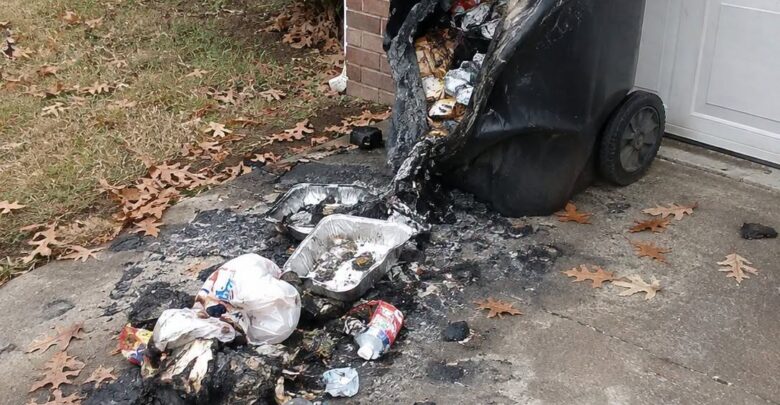
My trash can melted on Thanksgiving.
I found it at noon, when I went out with the kitchen trash.
I had the bag in one hand and the door open with my hip. I had a pie in the oven, potatoes waiting in the sink, and eleven people coming at three. I wasn’t thinking about anything except whether I’d remembered to buy cranberry sauce in a can. Danny’s kids won’t touch the real kind.
Then I got to the end of the driveway, and I stopped.
One side of the can had folded in on itself. It looked like a candle somebody had left on a windowsill in August. The green plastic had sagged and drooped and run, and then it had hardened again in a kind of frozen wave. The lid was warped so badly it was standing up on one corner.
There were ashes inside. Gray and white and powdery. And chunks of charcoal, some of them still black and some of them the pale gray that charcoal turns when it’s spent.
My potato peels from that morning were all over the driveway. My coffee grounds. The paper from the butter. The bag they’d been in had burned through at the bottom, and everything had spilled out when the side gave way.
I stood there holding my new bag of trash.
Next door, somebody was asking if there were any onions left.
I’d seen them that morning.
Denise and her guests. Around eight, while I was rolling out the pie crust at the kitchen window. They had a little portable charcoal grill set up on her side yard. The round black kind on three short legs. Four or five people were standing around it in their coats with coffee mugs, laughing. Someone was cooking sausages on it. Someone else was holding a pan of something over the coals with a pair of oven mitts.
I remember thinking it was a nice idea. A little breakfast cookout on Thanksgiving morning. I remember thinking, *Good for her. Her first holiday in the new house.*
That’s the kind of thing I think.
I knew where the charcoal came from.
I didn’t need anybody to tell me. There was only one little grill on our street that morning, and only one person who’d been putting things in my trash cans since the spring.
I also knew how the conversation at Denise’s door was likely to go.
I’d had enough conversations at Denise’s door by then.
I’m seventy-six.
My husband, Frank, and I have lived in this house for forty-one years. We bought it in 1983, when Danny was four and this whole street was half-built. There were still cornfields behind the back fence. You could hear the cows some nights.
Around here, I call people who moved in nine years ago “the new neighbors.” The Okafors across the street have been here twelve years, and I still think of them as the young couple. Their twins are in college now.
Denise had just moved in.
She bought the Hendersons’ place in April, after Marv Henderson passed and Ellen went to live with her daughter in Ohio. Ellen and I had been neighbors for thirty-three years. We’d traded zucchini and casseroles and keys. When Frank had his knee replaced, Ellen walked our dog twice a day for six weeks and never once let me pay her.
I cried when the moving truck took Ellen’s things away.
Then I baked a loaf of banana bread for whoever was coming next.
Denise was in her forties, I’d guess. Tall, quick, loud in a cheerful sort of way. She had two teenagers who came every other weekend, and a little white dog who barked at our mailman. She worked something in sales. She was always on the phone. She talked with her free hand.
I brought her the banana bread on her second day.
She took it at the door with one hand, still on the phone with the other, and mouthed “Thank you!” at me and smiled a big smile.
I thought we’d get along fine.
The first time I caught her in our garage, she had two of my flowerpots stacked in her arms.
It was a Tuesday in late April. I’d been in the backyard pulling weeds. I came around the side of the house to get my kneeling pad, and there she was. Standing in the middle of our garage, between Frank’s car and the workbench, holding my terra-cotta pots against her chest. The big ones. The ones I’d planted geraniums in every spring for twenty years.
Our rake was hooked over her elbow.
I asked what she was doing.
I didn’t say it sharply. I don’t think I’ve ever said anything sharply in my life. I just said, “Oh! Denise. What are you doing?”
She didn’t even look embarrassed.
“What’s the big deal? I just moved in, and I need so many things. I’ll return them later.”
And yes, I let her take them.
I stood in my own garage and watched her walk out of it with my flowerpots and my rake, and I didn’t say one single word.
I want to explain that, but I’m not sure I can. Not in a way that makes sense to anyone who isn’t me.
I suppose I figured I’d see her at the mailbox the next morning. I figured she’d bring them back, and we’d laugh about it, and that would be the beginning of being neighbors.
It seemed easier to let it go.
That’s the sentence. If you want to know about my whole life, that’s the sentence. *It seemed easier to let it go.*
A few days later, I needed the rake.
We’d had a windy night, and the last of the old oak leaves from the winter had blown out from under the hedges and all across the front lawn. I went to the garage and stood there looking at the empty hook where the rake used to hang.
So I went over to ask for it.
Denise was in her driveway, unpacking boxes from the back of her car. I walked up and said, “Good morning! I’m so sorry to bother you, but I need my rake back today, if that’s all right.”
She didn’t stop unpacking.
“Oh, sure. It’s around back. By the steps.”
And she went back to what she was doing.
I carried it home myself.
The rake was leaning against her back steps. Right where she’d said it would be. It had been out in the rain the night before. There was a little rust starting on the tines.
I picked it up.
And I almost thanked her.
I mean it. I picked up my own rake from her yard, and I turned toward her driveway, and the words “Thanks, Denise!” were right there in my mouth, ready to go.
I wish I were kidding.
I caught myself at the last second. I just walked home instead. I didn’t thank her. But I didn’t say anything else, either.
The flowerpots stayed where they were. I could see them from our kitchen window. She’d put them on either side of her front door with some yellow mums in them.
They looked nice there. I’ll say that.
Then it was the gardening tools.
A trowel. A hand rake. My long-handled cultivator, the one with the green tape wrapped around the handle where it had started to split. Frank had taped it for me ten years ago. He’s always taping things.
I didn’t catch her taking those. They were just gone, one by one, over a few weeks in May. I’d reach for them and find the nail empty.
I didn’t say anything.
I told myself I’d probably misplaced them.
Then it was the lawn mower.
Frank and I came home from the grocery store one Saturday in June, and the mower was gone.
Frank stood in the garage with a bag of groceries in each arm and stared at the empty spot by the wall.
“Ruth,” he said. “Where’s the mower?”
“I don’t know.”
“Did Danny borrow it?”
“Danny has his own mower.”
Frank put the groceries down on the hood of his car and got his phone out of his shirt pocket. We’d put in a little camera above the garage a couple of years before, after the Okafors had a package stolen. Frank checks it more than he needs to. He likes having something to check.
He scrolled back.
He found it.
Sure enough, there was Denise, pushing our mower across the grass.
We’d taken my car that day. His was still in the garage.
We watched the clip together, standing there with the groceries going warm. You could see her walk right in, look around, find the mower, and start wheeling it out backward. The garage isn’t wide. Frank’s car takes up most of it. She had to angle the handle very carefully to get around his side mirror. She took her time doing it.
She came awfully close.
Frank made a sound in his throat.
“Look at that,” he said. “Half an inch.”
“She didn’t hit it.”
“She came half an inch from it, Ruth.”
He saved the clip. Because of the mirror, he said.
I went over and asked for the mower back.
That afternoon. Frank wanted to go. I told him I would.
Denise was out back by her pool with a magazine. Our mower was sitting in the middle of her lawn. She’d cut about half the grass and stopped.
“Oh, hey, Ruth!” she said. “You need it already?”
“Frank likes to mow on Saturdays,” I said. Which was true.
“Sure, sure. It’s all yours. Hey, it’s kind of hard to start. You might want to get that looked at.”
I pushed it home across the grass myself.
The next time we saw Denise, at the mailboxes, we talked about the weather.
It was going to be hot that week. She thought it would rain on Thursday. I said I hoped so, for the gardens.
That was it.
Nobody said a word about the mower.
Frank stood next to me holding the mail. When we got back inside, he put it on the counter and looked at me for a long moment.
“The weather,” he said.
“What did you want me to say?”
“I don’t know, Ruth. Something.”
We used to leave the garage open during the day.
We’d always done that. Forty-one years. In the summer, especially. Frank would putter at the workbench, and I’d go in and out for my gardening things, and the neighbors would wave on their walks and sometimes stop to talk. Ellen used to come over and sit on the old kitchen chair Frank kept by the door, and we’d have iced tea in there out of the sun.
After the mower, I started closing it before we went out.
Then I started closing it when I was in the backyard, too.
Then I started closing it even when Frank was at the workbench, and he’d have to hit the button to open it again so he could get some air.
“It’s a garage, Ruth,” he said one day. “Not a bank vault.”
“I know.”
“So why are you closing it?”
I didn’t have a good answer. Or I had one, and I didn’t like it.
Of course, the rest of the yard was still right there.
One hot afternoon in July, I went out back to water my tomatoes, and the water wouldn’t come out of the hose.
I turned the faucet. Nothing. I turned it more. A little dribble.
Then I followed the faucet with my eyes.
There was a second hose screwed onto it. Not mine. A bright blue one. Brand new. It ran from our outdoor faucet, along the side of our house, across our lawn, across Denise’s lawn, under her fence, and straight into her pool.
I could hear it filling. That happy little gurgle.
The hose bothered Frank more than the mower.
He was in the den watching a ballgame. I came in and told him, and he got up out of his chair faster than I’d seen him move since his knee.
“Our water?” he said. “She’s filling her pool with our water?”
“It’s not the whole pool. She’s probably just topping it off.”
“Ruth. That’s our water bill.”
He was already heading for the back door.
He wanted to go over.
I told him I’d handle it.
I went outside.
I turned off the water. I unscrewed her blue hose from our faucet. My hands were a little shaky. I coiled it up neatly, all the way from our house to the property line, so it wouldn’t be a tangle for her. And then I left it, in a nice tidy circle, on her side of the grass.
That was my idea of handling it.
I want you to understand that I was proud of myself. For about ten minutes, I really was.
I’d done something. I’d stopped it.
I never said a word to her about it.
The next morning, the blue hose was gone. It never came back. Denise never mentioned it.
Neither did I.
Another time, I watched her cut three of my roses.
This was in August. My roses are along the front of the house, under the windows. Pink climbers. I planted them in 1991, the summer my mother died. They were her roses, cuttings from her yard. I rooted them in coffee cans on the windowsill, and when I planted them out, Frank built the trellis.
They’re the only thing in the yard I’d say I really love.
I was in the living room folding towels, and I looked out the window, and Denise was standing in my flower bed with a pair of kitchen shears.
Snip.
Snip.
Snip.
I went outside so fast I still had a towel in my hand.
I was going to tell her to put down the shears. I was going to say, *Those are my mother’s roses.* I really was. The words were right there.
“Denise—”
“Oh, Ruth, hi! These are gorgeous. I need a sample so I can plant the same ones. Do you know what kind they are?”
And you know what I said?
I asked what color she wanted.
I stood there in my flower bed with a bath towel over my arm, and I told her they also came in a deeper pink and a sort of peachy cream, and that if she wanted the climbing kind, she’d need a trellis, and that they liked morning sun better than afternoon.
I’d gone out to tell her to put down the shears.
Somehow, I was about to give her gardening advice.
She thanked me and walked home with three of my mother’s roses in her hand.
I went back inside and finished folding the towels. I folded every single one of them twice.
The trash was the first thing I ever asked her outright to stop.
Our pickup is Wednesday mornings. Frank and I are retired, and we’re tidy, and it’s just the two of us, so we don’t make much trash. One bag a week, sometimes two. Our two cans out front were always half empty by pickup day.
Then, starting sometime in September, they weren’t.
I’d go out on a Monday or Tuesday morning with our kitchen trash, and the cans would already be nearly full. Black bags I didn’t recognize. Big ones. Contractor bags.
I thought at first maybe the wind had blown something in. Then I thought maybe kids. I actually said that to Frank. “Maybe it’s kids.”
He just looked at me over his glasses.
Then I caught her.
A Tuesday evening in October. I’d gone out to get the mail late, and there was Denise, coming down her driveway with two enormous black bags. One in each hand. Heavy enough that she was leaning back to carry them.
She didn’t go to her cans.
She came to mine.
By the time I got down the driveway, the first one was already in.
“Denise,” I said. “Please use your own trash cans.”
I was polite. I’ve gone back over it a hundred times, and I’m sure I was polite.
She looked at me like I’d said something strange.
“Mine are always full, and yours are practically empty. You two are retired. How much trash could you possibly have? What’s the problem?”
“If you don’t have enough room in your trash cans,” I said, “please get some additional ones. The city will bring you another one. You just call.”
She rolled her eyes and dropped in the second bag.
“Pfft, and pay extra for them? No, thanks.”
She let the lid fall shut. It banged.
“Why are you being so stingy? I only threw a couple of bags of trash into your cans.”
And she walked away.
I stood there by my mailbox with a handful of mail. A seed catalog. The electric bill. A card from my sister in Tucson.
*Stingy.*
I’d never been called stingy in my life. I’m the woman who brings two casseroles when somebody dies. I’m the woman who still has a drawer full of birthday cards in case anybody on the street needs one. I gave Ellen Henderson my good winter coat the year her furnace broke and she had to wait three weeks for the part.
I walked back up the driveway feeling like I’d done something wrong.
That’s the part I can’t get over, even now.
She’d put her trash in my can. And I felt like I’d done something wrong.
I caught her doing it several more times.
Twice more in October. Three times in November. Always the big black bags. Always with that same breezy walk, like she was returning something to a shelf.
Once, she waved on her way back across the lawn.
She saw me in the window and waved. Big and friendly. Like we were the best of neighbors.
I waved back.
I’m telling you the truth. I waved back.
I kept thinking I’d said it politely enough.
Surely, I thought, I wouldn’t have to keep saying it. Surely she’d heard me. Surely one time was enough, for a grown woman, for something that simple.
*Please use your own trash cans.*
There’s nothing complicated in that sentence.
Frank asked me about it one evening, about a week before Thanksgiving.
He was at the kitchen table doing the crossword, and I was going out the back door with a bag of kitchen trash. Going the long way. Around the side of the house, past the hydrangeas, to the little can we keep by the back steps for yard waste and odds and ends.
“Ruth,” he said. “Where are you going with that?”
“Out back.”
“Why?”
I stopped with the door half open.
“Both cans out front are full again.”
He put his pencil down.
“Full of what?”
I didn’t answer.
“Full of hers,” he said. “Again.”
“I have room in the little can by the back door.”
“Ruth.”
“It’s fine, Frank. I’d rather make two trips than go next door and have the same conversation.”
He took off his glasses and rubbed his eyes.
Frank is not an angry man. In fifty-two years of marriage, I’ve seen him truly angry maybe five times. He doesn’t yell. He just gets very quiet and very tired-looking.
“You know what your mother used to say?” he said.
I did know. I didn’t want him to say it.
“Don’t make a fuss, Ruthie,” he said. “Don’t make a fuss, don’t make a scene, don’t make the neighbors talk.”
“She meant well.”
“I know she did. But she’s been gone thirty-three years, and you’re still carrying trash around the side of the house so you don’t upset somebody who calls you stingy.”
I stood in the doorway with the bag.
“I’ll handle it,” I said.
He put his glasses back on and picked up his pencil.
“That’s what worries me,” he said.
I took the trash out back.
Back to Thanksgiving.
I stood at the end of my driveway looking at that melted can for a long time. Long enough that the bag in my hand started to feel heavy.
Then I took the bag back inside and asked Frank to come look.
He was in the living room putting the extra leaf in the dining table. He came out in his slippers and his good sweater, the brown one Danny’s wife gave him. He stood over the can with his hands in his pockets.
He didn’t say anything at first.
He reached down and put the back of his hand near the side of it. Not touching. Just near.
“It’s still warm,” he said.
“Is it?”
“Ruth. If that had been up against the garage—”
He didn’t finish. He didn’t need to. The can sat at the end of the driveway, away from the house, on the concrete. But on another day, if Frank had rolled them up by the garage door the way he sometimes does when it’s windy—
Frank went and got the garden hose. He sprayed the inside of the can down until the ashes were a gray soup and the steam stopped coming off. It hissed. That hissing sound was the worst part, somehow.
We waited for it to cool all the way.
Once we could move it safely, I wheeled it next door.
Frank asked if I wanted him to come.
“No,” I said. “I’ll do it.”
He looked at me like he wanted to argue. Then he just nodded and went back inside. I saw him in the front window, though. Watching. Not even pretending he wasn’t.
Only one wheel turned properly. The other one had melted at the axle and just dragged.
I had to tip the thing almost sideways to get it up the little step to her front walk. I’m seventy-six, and I have a bad shoulder from the year I fell on the ice. It took me three tries. The can scraped and thumped and left a black streak on her walk.
I could hear them inside the whole time. Talking, laughing. A football game on loud. Someone shouting “Go, go, go!” at the TV.
I rang the bell.
Denise opened the door with a dish towel over her shoulder and a glass of wine in her hand.
Behind her, the house was full. Coats piled on the stairs. A folding table set up in the front room because the dining table wasn’t big enough. A tall man in a football jersey. Two women about Denise’s age. Her teenagers on the couch on their phones. A little boy running in circles.
The smell of turkey came out the door. And onions.
“Ruth!” she said. “Happy Thanksgiving!”
“Did you dump hot coals into my trash can?” I said. “Look what you’ve done!”
I’d barely gotten the can upright. It was leaning against my hip.
She took one look and waved it off. With the hand holding the wine.
“I cleaned out the grill,” she said. “I thought the coals had already cooled down.”
She shrugged.
“It’s no big deal. Just buy a new trash can.”
I gripped the handle with both hands.
I was shaking. Not just my hands. All of me. The way you shake when you’ve been cold for a long time and finally come inside.
Behind her, someone reached across the folding table for a roll.
I watched that hand. A man’s hand, big and casual, taking a roll like nothing was happening at the door.
“Denise,” I said. “I need you to replace it.”
She laughed. A short little laugh, the kind you give a child who’s being dramatic.
“Ruth, come on. It’s a trash can. They’re, what, thirty bucks at the hardware store? You’re retired. You’ve got money. Don’t be such a cheapskate.”
The word hung there between us.
*Cheapskate.*
Behind her, the football game roared. Somebody scored. The little boy screamed with joy.
I stood on her front step with my melted trash can and the smell of her turkey coming out the door, and for the first time in eight months I didn’t look for a way to make it easier.
“I want a new one,” I said. “The same kind. And I want you to pay for it.”
She rolled her eyes so hard I could almost hear it.
“Fine. Whatever. I’ll Venmo you or something after the holiday. Now can I get back to my family?”
She started to close the door.
I put my hand on the frame.
I don’t know where that came from. I’ve never put my hand on anybody’s doorframe in my life.
“No,” I said. “Not Venmo. Not after the holiday. I want it in writing. And I want it by Monday.”
She stared at me.
For a second she looked almost amused. Then she didn’t.
“Are you serious right now? On Thanksgiving?”
“Yes.”
She looked past me, toward my house. Toward the window where Frank was still standing.
“You’re really going to make a scene about a trash can,” she said. “In front of my whole family.”
“You already made the scene,” I said. “When you put hot coals in my can.”
Somebody behind her called her name. One of the teenagers, I think. Asking where the gravy was.
Denise looked at me one more time.
Then she closed the door.
Not hard. Just firmly. The way you close a door on a salesman.
I wheeled the can back home.
Frank met me at the end of the driveway. He took the handle without a word and helped me get it up onto our own walk.
We stood there looking at it.
“Well?” he said.
“She said she’d pay for a new one.”
“Did she.”
“She called me a cheapskate.”
Frank’s jaw tightened.
“Of course she did.”
We went inside. The pie was almost done. The potatoes were still waiting in the sink. Eleven people were coming at three, and I still hadn’t made the cranberry sauce.
I stood at the kitchen counter with my hands on the edge of the sink and tried to breathe.
Frank came up behind me and put his hands on my shoulders.
“You did good,” he said.
“I don’t feel like I did good.”
“I know. But you did.”
The rest of Thanksgiving went the way Thanksgivings go. People came. People ate. Danny’s kids complained about the cranberry sauce even though I’d bought the canned kind. Someone spilled gravy on the good tablecloth. Frank told the same story about the year the turkey caught fire in 1989, and everybody laughed the way they always do.
I smiled. I passed the rolls. I said all the right things.
But the whole time, part of me was still standing on Denise’s front step with that melted can.
That night, after everyone had gone and the kitchen was mostly clean, I sat at the table with a pad of paper and a pen.
Frank was loading the dishwasher.
“What are you writing?” he asked.
“A letter.”
He came and looked over my shoulder.
I wrote it carefully. The date. Her full name. The address. Exactly what had happened. The date I’d found the can. The fact that the coals were still warm. The cost of a replacement can of the same size and quality—$68.49 at the hardware store on Main Street. I included the receipt from when we’d bought the original ones two years before.
I wrote that I expected a check or cash for the full amount by the following Monday, and that if I didn’t receive it, I would be filing a claim with the small claims court and providing the video evidence from our garage camera.
I almost didn’t write that last part.
Then I thought about the word *cheapskate*, and I wrote it.
Frank read the whole thing twice.
“You sure?” he said.
“I’m sure.”
He nodded.
“I’ll drive you to the post office in the morning.”
I put the letter in an envelope. I addressed it. I stuck a stamp on it.
Then I went to the cabinet above the fridge and took down the good platter. The one with the blue flowers around the rim. The one I’d been saving for special occasions and almost never used.
I wrapped it in newspaper. I put it in a box. I wrote Denise’s name on the top.
Frank watched me do it.
“What’s that for?”
“I’m taking it over with the letter.”
“Ruth—”
“I’m not giving her the platter,” I said. “I’m just making a point.”
He didn’t ask what the point was. He already knew.
The next morning I walked the letter and the box next door myself.
Denise’s driveway was empty. The guests were gone. The little grill was cold on the side yard.
I left the envelope and the box on her front step.
I didn’t ring the bell.
I walked home.
That afternoon the phone rang.
It was Denise.
She was crying. Or something close to it. Her voice was high and tight.
“What is this?” she said. “What is this letter? Are you serious? You’re threatening to take me to court over a trash can?”
“I’m asking you to replace what you destroyed.”
“And what’s with the platter? Are you trying to make me feel guilty? Is that some kind of passive-aggressive thing?”
“It’s a platter,” I said. “I thought you might need one. For next year.”
There was a long silence.
“You’re unbelievable,” she said. And she hung up.
I set the phone down.
Frank looked at me from the doorway.
“Well?” he said.
“She got it.”
He came over and put his arm around me.
“Good.”
I stood there in my kitchen with the smell of leftover turkey still in the air, and for the first time in eight months I didn’t feel the need to go next door and smooth anything over.
It was a lot easier to say that in my own kitchen. With the door locked and the porch light on and Frank’s arm around me and the dishwasher running.
I put the platter back in the cabinet above the fridge where it lives. Up high, where it’s safe. Next to the gravy boat my mother got for her wedding in 1946.
I slept better that night than I had in months.
On Monday, I talked to a woman named Carol.
She called at ten on the dot. She had a kind, slow voice, like a radio host who does the late-night show. She told me she’d been a mediator for the county for sixteen years. Before that she’d been a high school guidance counselor.
“So I’ve heard a lot of people explain why something wasn’t their fault,” she said. “You’d be amazed how similar it sounds at sixteen and at sixty.”
I laughed. It surprised me, that I laughed.
She asked me to tell her what had happened.
I started with the can.
I told her about the charcoal, and the ashes, and the potato peels on the driveway. I told her about wheeling it over, and the door, and the retirement money. I told her about the camera.
She listened. She made little “mm-hmm” sounds. Every so often she asked a question. When did that happen? Was anyone else there?
Then she asked me something I wasn’t ready for.
“Mrs. Talbot,” she said. “What do you want to happen?”
I opened my mouth to say, *I want her to pay for the can.*
Somehow, I ended up talking about the rake.
I don’t know why. It just came out. I told her about the day back in April, when I went next door to ask for it. How Denise had told me where it was without even stopping what she was doing. How I’d walked around to her back steps and picked it up myself.
How it had been out in the rain. How there was rust on it.
“She pointed me toward it,” I said. “And went right back to what she was doing. As if—”
I stopped.
“As if what?” Carol said.
“As if she’d been doing me a favor. By setting it out where I could find it.”
Carol was quiet for a moment.
“And how did you feel,” she said, “picking it up?”
“I almost thanked her,” I said. “I almost said thank you. For my own rake.”
I sat at my kitchen table with the phone pressed to my ear. Frank was in the den with the door open, pretending to read the paper.
“Mrs. Talbot,” Carol said gently. “Can I ask you something?”
“Of course.”
“The next time you need the rake, where do you want it to be?”
I didn’t even have to think.
“In my garage,” I said. “Where I put it.”
My voice cracked a little on the last part. I don’t know why. It was such a simple thing to say.
“Okay,” said Carol. “Then that’s what we’ll talk about.”
The center called Denise separately. That’s how they do it, Carol explained. They call both people. Both people have to agree to sit down.
She could’ve said no. Nobody makes you go. It’s all voluntary.
She told me later she agreed because she wanted to settle everything in one conversation. She didn’t want it dragging on. She didn’t want to keep waiting for the next platter.
By then we’d passed at the mailbox twice without speaking.
Tuesday and Thursday. Both times, she was getting her mail just as I came down. Both times, we stood eighteen inches apart, opening our little metal doors, not looking at each other.
I was tired of it too.
The second time, I nearly said something about the weather.
It was cold that day. The first real cold of the year. My breath was making little clouds, and I almost said, *Well, winter’s here.* I could feel it in my mouth, ready. The old habit.
I didn’t.
Old habits, I guess. They don’t die. You just stop feeding them, and eventually they get quieter.
We met the next week. A Wednesday afternoon, at the mediation center. It’s in an old brick building downtown that used to be a bank. They’ve got little rooms in the back that used to be offices, with plants and boxes of tissues and big windows.
Frank drove me. He waited in the car with a thermos of coffee and his crossword.
“Take as long as you need,” he said.
“It’s a trash can, Frank. It’s not going to take that long.”
He looked at me over his glasses.
“It’s not a trash can, Ruth,” he said. “And you know it.”
Carol sat with us at a little round table.
She was older than I’d pictured. Sixties, with white hair in a short cut and big red reading glasses on a beaded chain. She had a yellow legal pad and a cup of tea. She’d brought cookies on a paper plate. Shortbread.
“Nobody ever touches them,” she said. “But I like to have them.”
Denise came in a few minutes after me. She was in her work clothes, a blazer and slacks. She looked tired. She sat down across from me and put her purse on the floor.
She’d brought my letter.
She’d folded it in thirds, like you’d fold a bill. She unfolded it and put it on the table between us, and she tapped the price with her finger.
$68.49.
“I said I’d pay this,” she said. “I said that already. On Thanksgiving. I don’t know what else you want me to say about the charcoal. I thought it was cold.”
“I believe you thought it was cold,” I said.
She looked up at me.
I think she’d come ready to argue that point. I think she’d practiced. I could see it in her face, all the arguments lined up behind her eyes. *The coals looked gray. Anybody could’ve made that mistake. It was an accident.*
I’d taken that away from her. She didn’t know what to do.
I put my phone between us.
I’d had Frank show me how to make the clip start at exactly the right moment. I pressed play.
I played it from the second she opened her own can.
All three of us watched. Carol leaned in with her red glasses. Denise sat very still.
On the little screen, Denise looked into her own can. Saw the bags. Shut the lid.
And crossed the lawn.
Opened mine. Tipped the grill. Closed my lid, nice and neat.
The clip ended. The little screen went still on the image of my can, with the gray ash floating up out of it.
When it ended, she waited for me to pick up the phone.
I left it there.
On the table between us. With the picture of my can on it.
“What made you come over to mine,” I said, “after you checked yours?”
She took a long time to answer.
“Mine was full,” she said. “I figured you’d have room.”
I let a few seconds go by.
I didn’t say anything. Carol didn’t either. The radiator ticked under the window. Somebody’s phone rang in another room.
I wanted her to hear it. How it sounded. How familiar it was.
*I need so many things. I’ll return them later.*
*I figured you’d have room.*
“I’d asked you to use your own, Denise,” I said.
She pulled the letter toward her and worked a thumb along one of the folds. Back and forth. Smoothing it, then creasing it again.
“Well,” she said. “Your garage is always open.”
She didn’t look at me.
“I thought we were the kind of neighbors who could borrow from each other.”
There was a long pause.
I could feel something rising in my chest. That old feeling. The one that says, *Oh, she didn’t mean any harm. She just has a different idea of neighbors. Maybe she grew up somewhere where everybody shares. Maybe you’re being too rigid, Ruth. Maybe this is your fault for leaving the garage open.*
I let it rise. I let it sit there.
Then I reached over and picked up my phone, and I pulled up the mower clip.
There she was. On the little screen. Walking into our garage on a sunny June morning. Finding the mower. Pulling it backward, very slowly, very carefully, angling the handle so it wouldn’t touch Frank’s side mirror.
It took her almost twenty seconds to get it around.
Twenty seconds of being careful.
She could’ve taken another ten seconds to text me.
“We were out buying groceries,” I said. “You could have called me. You could have waited until we got home. I only got it back because I came over and asked where it was.”
She started to say something.
Then she looked down at my phone again. At herself, on the little screen. Pushing my mower across the grass.
She didn’t say it.
“I figured you’d come get it if you needed it,” she said finally.
It had always been my job to come get it.
I sat there and understood that. All at once, like a light coming on in a room you’ve been sitting in for a long time in the dark.
The rake. The mower. The hose. The trash. It had always been my job to come get it. My job to notice. My job to walk over and ask, and feel bad about asking, and say it nicely, and then carry my own things home. She’d made it my job. And I’d let her. Because it seemed easier.
It wasn’t easier.
It was just quieter.
So I told her.
Not angry. I wasn’t angry anymore. Just plain.
I told her I’d unhooked her hose myself. In July. That it had been running our water into her pool, and I’d coiled it up and left it on her side because I didn’t want to have to talk to her about it.
She looked surprised. Like she’d forgotten. Maybe she had.
I told her I’d seen her cut my roses. That they were my mother’s roses. That I’d rooted them in coffee cans the summer she died.
Denise put her hand over her mouth at that. Just for a second.
I told her I wanted to leave my garage open while I worked in the yard. That I’d left it open for forty-one years. That Ellen Henderson used to come and sit in there with me and drink iced tea.
And I told her I was tired.
I was tired of wondering what I’d have to go next door to get back.
Denise was quiet for a while.
She looked at the window. At the bare tree outside it. A pigeon was sitting on a branch, all puffed up against the cold.
When she spoke, her voice was different. Smaller. Not the big, breezy voice from the driveway.
“I grew up in an apartment building,” she said. “In Chicago. Six floors. My mom was a single mom. Everybody borrowed everything. Sugar, eggs, the vacuum. Mrs. Kowalski on three had the only good ladder in the building, and everybody just went and got it. Nobody asked. You just took it and brought it back.”
She shrugged one shoulder.
“I guess I thought that’s how it worked. Houses too.”
Carol wrote something on her legal pad.
“Did you bring it back?” I asked. “The ladder? When you were done?”
Denise opened her mouth.
Then she closed it.
“Yeah,” she said. “Usually. My mom would make me.”
“And this is my first house,” she said. “Ever. I’m forty-four. I’ve rented my whole life. After my divorce I didn’t think I’d ever be able to buy anything. And then I did, and I moved in, and I had nothing. No rake. No mower. No hose. No pots. I’d never needed any of it. And it was all just sitting there in your garage.”
She laughed a little. Not a happy laugh.
“It’s expensive, owning a house. Nobody tells you. Every single week there’s something else.”
I believed her.
I want to be honest. I sat there and I believed every word of it, and I felt for her. I remembered Frank and me in 1983, with a four-year-old and a house full of nothing and a lawn we didn’t know how to take care of. Frank borrowed a mower from Marv Henderson that whole first summer.
He asked first. Every single time. He knocked on the door and asked, and brought it back that afternoon with the bag emptied and the blades wiped clean. And by August, Marv was telling him, *Frank, just come get it, you don’t need to ask.* And Frank still asked.
That was the difference.
It had never been about the borrowing.
“I understand,” I said. “I really do, Denise. But you called me stingy. You called me a cheapskate. On my own walk. In front of your family.”
She flinched.
“I know.”
“I’ve lived on that street forty-one years. Nobody’s ever called me stingy.”
“I know,” she said again. Quieter. “That was— I was embarrassed. My sister was right there. My ex’s brother was there. I’d just burned your trash can, and I knew it, and I was embarrassed, and I just— I made it your fault. So it wouldn’t be mine.”
She looked down at the letter.
“I’m sorry,” she said. “About that part. About what I said.”
It wasn’t a big apology. It wasn’t the kind you see in movies.
But she said it. And she looked at me when she said it.
“Thank you,” I said.
And I meant it. Not the way I’d almost meant it about the rake. The real way.
Then she asked what she still had.
I hadn’t expected that. I don’t think Carol had either. She looked up from her legal pad.
“Of my things?”
“Yeah,” Denise said. “I honestly don’t know. I’m not trying to be— I really don’t know. Tell me.”
So I told her about the trowel and the long-handled cultivator. The flowerpots, I said, she could keep. They looked nice by her door. I’d planted geraniums in them for twenty years, and I was ready for something new anyway.
“The cultivator had green tape on the handle,” I said. “My husband taped it.”
That jogged her memory. I saw it happen.
“Oh my God,” she said. “It’s behind my shed. I used it to dig up the old bushes by the fence in May. It’s been sitting back there ever since. The trowel too, I think.”
“Since May.”
“Since May,” she said, and she actually winced.
Carol helped us put it in writing.
That’s what they do. They write it all down, in plain words, and both people sign. It’s not a court thing. Nobody’s going to arrest you if you break it. But it’s on paper, with your name.
Carol wrote it out on her legal pad first, and read it back to us, and we changed a few words. Then she typed it up on the computer in the corner and printed two copies.
Denise would pay for a new can. Sixty-eight dollars and forty-nine cents.
She’d take away the ruined one and the bag of trash we’d picked up off the driveway. Frank had put it in a contractor bag by the side of the garage, and it had been sitting there for two weeks.
She’d bring the tools back by Saturday.
She agreed to stay out of the garage unless invited.
She’d use her own faucet and her own cans. If her cans were full, she’d call the city for another one.
The roses were to stay where they were.
And if she wanted to borrow something, she’d knock and wait for an answer.
I read that last bit again before I signed.
*If she wanted to borrow something, she’d knock and wait for an answer.*
So did Denise. I watched her read it. Her lips moved a little.
It felt odd to have it written down. Like something you’d put on a poster in a kindergarten classroom. *Knock and wait for an answer.* It’s the first thing you teach a child.
But that was the part I wanted us both to remember.
Not just her. Both of us.
Because the answer was mine to give. That’s what I’d forgotten, all those months. She’d never waited for my answer. But I’d never given one, either. Not really. I’d given her the weather.
We signed.
Carol shook both our hands. She offered us the shortbread. Nobody took any. She laughed.
“Told you,” she said.
Denise and I walked out to the parking lot together. Not side by side, exactly. A few feet apart. It was getting dark already. That early December dark.
At her car, she stopped.
“Ruth,” she said. “The roses. Your mom’s roses. I put the cuttings in water. They rooted. They’re on my kitchen windowsill.”
I didn’t know what to say.
“I can bring them back,” she said. “If you want.”
I thought about it. About my mother. About coffee cans on a windowsill in 1991.
“Keep them,” I said. “Plant them in the spring. By the fence, where they’ll get morning sun.”
She nodded.
Then she got in her car, and I got in ours, and Frank looked at me and said, “Well?”
“I’ll tell you at home,” I said.
He didn’t push. He just started the car.
On Saturday, I heard a knock just after breakfast.
Frank and I were at the kitchen table with our coffee. He looked at me. I looked at him.
A knock.
In eight months, that was the first time I’d ever heard Denise knock on our door.
I went and opened it.
Denise was on the step with the two tools and an envelope.
She’d rinsed the dirt off the cultivator. You could tell. It was still a little damp. The tines were clean, and she’d wiped the rust off them, or tried to.
The green tape was still on the handle.
Frank’s tape. Ten years old, a little faded, peeling at one end.
She held them out. I took them.
Then she held out the envelope.
I counted the money while she stood there.
I want you to know I’d never have done that before. Before, I’d have taken the envelope and said, *Oh, you didn’t have to,* and put it in my pocket without looking. Because counting it in front of her would’ve felt rude. Would’ve felt like I didn’t trust her.
I counted it.
Three twenties, a five, three ones. And two quarters, a dime, and four pennies.
It was the amount in the letter. To the penny. She’d even rounded up the change.
“Thank you, Denise,” I said.
“Sure,” she said.
She didn’t say anything about the weather.
She took the melted can and the bag we’d set beside it.
She had to carry the bag first, back to her own cans, and come back for the can. The can was harder. The one bad wheel just dragged on the concrete with an awful scraping sound.
One wheel caught where the driveway met the street. There’s a little lip there, where the city repaved a few years back. It caught and stuck, and the whole can tipped sideways and almost went over.
I almost went out to help.
I had my hand on the door. I had my foot on the step. Every bit of me wanted to go down there and grab the other side and say, *Here, let me.*
I stood still.
She backed up. She turned the can. She tipped it the other way and got it over the lip, and got it moving herself.
I watched her drag it all the way down the street to the end of her own driveway.
Then I closed the door.
Frank was standing right behind me in the hall. He’d watched the whole thing.
“You wanted to help her,” he said.
“I did.”
“But you didn’t.”
“No.”
He kissed me on the forehead. He hasn’t done that in a while. He mostly does the cheek now.
“Your mother would’ve gone out there,” he said.
“I know.”
“I’m glad you didn’t.”
I hung the cultivator back on its nail in the garage that afternoon. Right where it belonged. With the green tape facing out.
Then I left the garage door open.
All afternoon. While I raked the last leaves out of the flower beds, and wrapped the roses in burlap for the winter, and swept the front walk.
Frank came out and sat on the old kitchen chair by the door with a cup of coffee and watched me work. Just like Ellen used to.
“It’s nice,” he said. “Having it open.”
“It is,” I said.
A week later, I was in the kitchen when she knocked again.
It was a Sunday, around one. I was making soup. Frank was asleep in his chair with the football game on.
The garage was open.
I’d been working out there all morning. I’d come in to check on the soup and hadn’t bothered to close it. I didn’t think about it until I heard the knock.
I went to the front door.
Denise was on the step in a sweatshirt and jeans and gardening gloves.
“Hi, Ruth,” she said. “Sorry to bother you. Could I borrow your pruning shears?”
The shears were on the workbench.
I knew exactly where they were. I’d been using them that morning. They were sitting right next to the vise, on a folded rag, where I’d left them when I came in.
I could’ve lent them to her for an hour.
I almost said so.
The words were right there. *Of course! They’re on the workbench. Just bring them back when you’re done.* They were all lined up in my mouth, ready to go, the way they always had been.
Then I thought, *I’d spend the afternoon wondering.*
Wondering whether she’d bring them back. Wondering when. Wondering if I’d need to go over and ask. Wondering if I’d find them a week from now, out in the rain, leaning against her back steps.
“I’m using them this afternoon,” I said.
It was true. I was going to trim the roses back before the hard freeze. I’d planned it all week.
But it would’ve been true even if it wasn’t. That’s what I’d finally figured out. It’s my garage. They’re my shears. And the answer was mine to give.
Denise nodded.
She didn’t roll her eyes. She didn’t sigh. She didn’t call me stingy.
“Okay,” she said. “I’ll see you later, Ruth.”
She walked home.
Across the grass. To her own house. Where I could see two little coffee cans on the kitchen windowsill, with green shoots coming up out of them.
I went back to what I’d been doing.
I stirred the soup. I turned it down to simmer. I woke Frank up for the second half of the game, and he grumbled, and I put a blanket over his knees.
Later that afternoon, I put on my coat and my gardening gloves and went out to the garage.
When I went out to trim the roses, my shears were right where I’d left them.