Uncategorized
CRUEL TEACHER MOCKS GIRL IN HANDMADE PROM GOWN UNTIL POLICE OFFICER REVEALS THE HEARTBREAKING TRUTH

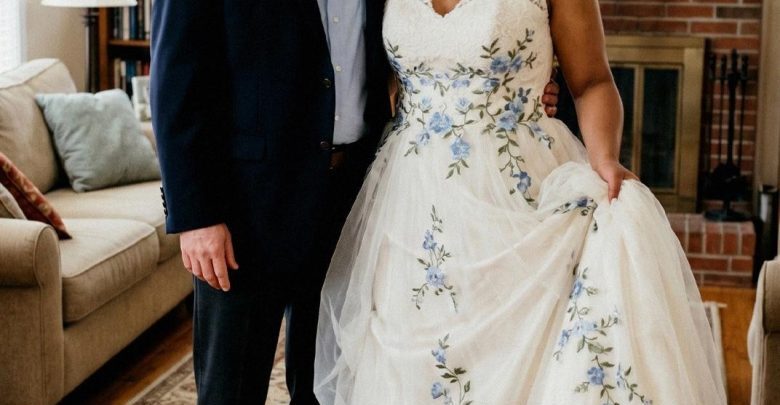
The living room of our small home had always been a place of quiet resilience, but in the spring of my senior year, it transformed into a sanctuary of secrets and stitching. My father, John, was a man built of grit and industrial grease. He was a plumber by trade, possessed of hands that were permanently stained by the labor of fixing what the world had broken. He was more comfortable with a pipe wrench than a needle, yet there he was, hunched over an ancient sewing machine with a pair of drugstore reading glasses perched precariously on his nose. When I first caught him at the dining table, surrounded by drifts of ivory silk and spools of delicate thread, I genuinely feared the stress of raising a daughter alone had finally snapped his mind. He was a man who owned three identical work shirts and thought a five-course meal was chili served with five different kinds of crackers. Seeing him guide fabric through a machine with the tenderness of a heartbeat was the most jarring sight of my life.
I leaned against the doorframe, watching him struggle with a stubborn hem. I asked him when he had joined the guild of tailors, and without looking up, he muttered something about YouTube tutorials and my late mother’s old sewing kit. My mother had passed away when I was only five years old, leaving behind a silence that my father spent the next decade trying to fill with bad jokes and unwavering support. We were our own little island, surviving on tight budgets and his ability to stretch a paycheck until it screamed. By the time prom season arrived, the high school hallways were buzzing with talk of thousand-dollar gowns and rented limousines. I knew the reality of our bank account, so I told him I’d just borrow a dress from a friend. I lied and said I didn’t care about the dance, but he saw right through me. He told me to leave the dress to him, a sentence that sounded insane coming from a man who wore work boots older than I was.
For the next month, the hum of that sewing machine became the soundtrack of our nights. I would wake up to find stray threads on the sofa and my father nursing a thumb where the zipper had apparently fought back. He was exhausted, juggling extra plumbing shifts with his new obsession, but he refused to let me see what he was creating. At school, the pressure was different but equally draining. My English teacher, Mrs. Tilmot, seemed to have made it her personal mission to ensure I felt every bit of the “poverty” she assumed defined me. She was the kind of woman who wore her cruelty like a designer scarf—quiet, elegant, and suffocating. She never yelled; she simply used a tone of voice that made you feel like you were an inconvenience to the air you breathed. She called my work lazy and my presence exhausting. I tried to act like her barbs didn’t stick, but by the time prom night arrived, my nerves were frayed thinner than a worn-out lace.
A week before the dance, Dad finally invited me into his workshop. He looked nervous, his large hands trembling slightly as he unzipped a garment bag. When the fabric spilled out, I stopped breathing. It was a gown of luminous ivory, shimmering with a soft, ethereal light. He had hand-stitched delicate blue flowers across the bodice, each one placed with a precision that must have taken hours of agonizing work. He cleared his throat and confessed the truth: he had taken my mother’s wedding dress out of the attic and spent his nights redesigning it for me. He said he knew my mom would have wanted to be there, and since he couldn’t bring her back, he wanted to make sure a part of her could walk beside me. I didn’t just cry; I sobbed. I felt the weight of his love in every stitch, a physical manifestation of a man who didn’t know how to say “I love you” with words, so he said it with silk.
The night of the prom felt like a fever dream. When I looked in the mirror, I didn’t see the daughter of a struggling plumber or the girl Mrs. Tilmot liked to humiliate. I saw a girl who was cherished. I arrived at the hotel ballroom feeling as though I was wearing a suit of armor made of memories. My friends gasped, and even the boys in my class seemed stunned by the transformation. For one glorious hour, I felt like I belonged. That feeling lasted until Mrs. Tilmot appeared, a champagne flute in one hand and a look of pure disdain in her eyes. She didn’t offer a compliment. Instead, she announced to everyone within earshot that if the theme of the night was an attic clearance sale, I had certainly won. She laughed, a cold, sharp sound that cut through the music, and called my mother’s legacy a “home economics project made of old curtains.” She even reached out to mock the hand-stitched flowers, calling them “pity stitches.”
The room went cold. I felt the old shame rising in my throat, the familiar urge to disappear into the floorboards. But before I could break, a voice cut through the tension. Officer Warren, the school’s resource officer, stepped forward. He wasn’t there for the festivities; he was there for a reckoning. It turned out my father hadn’t just been sewing; he had been advocating. After months of reporting Mrs. Tilmot’s targeted bullying to the administration with no results, he had escalated the matter, providing documented evidence of her harassment. Officer Warren informed her, in front of the entire student body, that a formal review had concluded and she was to leave the premises immediately. The assistant principal stood beside him, looking on with a grim expression, noting that even after a final warning, she had chosen to humiliate a student while intoxicated at a school event.
Mrs. Tilmot’s face went from pale to a sickly shade of red as she realized her reign of terror was over. She tried to protest, claiming it was just a harmless comment, but the room was no longer under her spell. As Officer Warren led her toward the exit, I found my voice. I told her that she had always tried to make me feel ashamed of being poor, but that I had realized I was richer than she could ever imagine. The silence that followed her departure was brief, quickly replaced by a low whistle of admiration from a classmate who had overheard the truth about my gown. He called my dad a genius. Suddenly, the ivory silk didn’t feel like a reminder of what we lacked; it felt like a trophy of what we had.
I danced until my feet ached, buoyed by the realization that my father had given me much more than a dress. He had given me a shield. When I finally walked through our front door late that night, the house was quiet, and the sewing machine was tucked back into the closet. My father was waiting up for me, looking small in his armchair but sporting a giant smile when he saw the zipper had survived the night. I told him that everyone saw what I already knew: that his love looked better on me than any designer label ever could. We sat in the kitchen, two halves of a whole, finally at peace. The dress was eventually tucked away, but the strength I found in those ivory threads remained, a permanent reminder that even when the world tries to stitch you into a corner, love can always craft a way out.