Uncategorized
The Trail Back to Bella: The Battle That Changed Everything Nëntitulli:
On November 9, 2007, a U.S. patrol left a remote village in Afghanistan’s Nuristan Province. The journey back to Combat Outpost Bella would become a fight for survival

The Trail Back to Bella: The Battle That Changed Everything
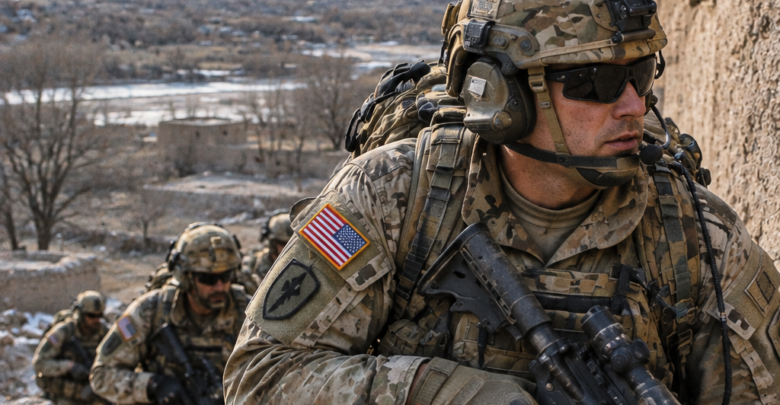
On November 9, 2007, a U.S. patrol left a remote village in Afghanistan’s Nuristan Province. The journey back to Combat Outpost Bella would become a fight for survival.
The mission began in darkness.
On November 8, 2007, members of 1st Platoon, Chosen Company, 2nd Battalion (Airborne), 503rd Infantry Regiment, 173rd Airborne Brigade left Combat Outpost Bella on foot. Their destination was Aranas, a remote village in the mountains of eastern Afghanistan.
Fourteen Americans, accompanied by approximately a squad of Afghan National Army soldiers, moved through the night toward an American-built schoolhouse on the edge of the village. They would spend the night there before attending a shura—a meeting with local elders—the following day.
The patrol was entering difficult country. The mountains around Aranas created narrow routes, steep slopes and high ground that could dominate movement below. Even before the events of November 9, the area had given the soldiers reasons for caution. An earlier attack on Combat Outpost Ranch House had wounded elevenpersonnel and contributed to that outpost being closed
By daylight, the soldiers prepared for the meeting.
But it did not begin as expected.
Village elders were said to be praying, and the shura was delayed for several hours. When it finally began in the early afternoon, the turnout was unusually large. At first, the level of participation appeared encouraging.
Then something changed.
An interpreter began hearing radio traffic in a language he could not understand. Marine Sgt. Phillip A. Bocks became concerned enough to advise platoon leader 1st Lt. Matthew C. Ferrara that the patrol should leave. U.S. Army
The meeting ended.
The Americans and their Afghan partners began the difficult journey back toward Bella.
The narrow trail
Among the soldiers was 20-year-old Specialist Kyle J. White, serving as the platoon’s radio telephone operator.
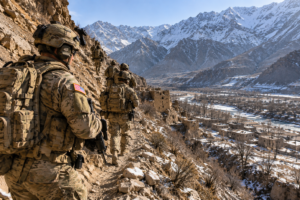
The route offered few good choices. To return to the outpost, the patrol had to move through steep, rocky terrain along a narrow mountain trail.
It was the kind of landscape where whoever controlled the high ground could see—and fire upon—the people below.
As the patrol moved away from Aranas, the attack began.
Enemy fighters opened fire from elevated positions. The soldiers on the trail were caught against the mountainside with very little cover or concealment. The attack was not confined to one location: U.S. Army accounts describe a broader, three-pronged engagement affecting elements of Chosen Company.
White returned fire.
Then a rocket-propelled grenade exploded near his position.
The blast briefly knocked him unconscious. After he regained consciousness, another impact sent fragments into his face. Despite his own injuries, White remained on the mountainside with wounded members of the patrol. U.S. Army
What followed would become the central part of his Medal of Honor citation.
A belt on a mountainside
White saw fellow soldier Kain Schilling wounded again, this time in the leg.
He moved to him under fire.
With Schilling bleeding heavily, White removed his own belt and used it as an improvised tourniquet to control the hemorrhage. U.S. Army
Nearby, platoon leader Matthew Ferrara lay motionless on the trail.
White left Schilling and moved toward Ferrara, again exposing himself to enemy fire. When he reached his platoon leader, he discovered that Ferrara had been killed.
He returned to Schilling.
Communication was another problem. Radios had been destroyed during the fighting, complicating efforts to coordinate assistance. White gathered sensitive equipment, including weapons and radios, so that it would not be left behind. U.S. Army
The battle continued.
Minutes became hours.
Four hours
The fighting lasted more than four hours.
White was suffering from the effects of multiple concussions, but the evacuation of the wounded remained the priority.
As his own condition deteriorated, he requested an immediate medical evacuation for Schilling. White helped identify and mark the evacuation location and assisted as wounded personnel were moved to the helicopter.
Only after the wounded had been evacuated did White allow himself to leave the mountainside. U.S. Army
By the time the attack ended, six American service members had been killed and others wounded. U.S. Army
They were:
Marine Sgt. Phillip A. Bocks
Capt. Matthew C. Ferrara
Spc. Joseph M. Lancour
Cpl. Sean K.A. Langevin
Sgt. Jeffery S. Mersman
Cpl. Lester G. Roque
Their names would remain closely connected to the story of the Battle of Aranas and to White himself. Years later, surviving members wore wristbands bearing the names of the six men who did not return.
Seven years later
The events on the mountain did not immediately become a widely known American story.
Years passed.
On May 13, 2014, Kyle J. White received the Medal of Honor for his actions in Nuristan Province on November 9, 2007. The Army’s official citation describes his repeated exposure to enemy fire while assisting wounded soldiers despite being wounded himself. U.S. Army
But White consistently redirected attention toward the men who had been with him.
After receiving the medal, he spoke about the six men killed during the battle and the bracelet he wore carrying their names. U.S. Army
That detail changes how the story can be understood.
The Battle of Aranas is remembered partly because one soldier eventually received the United States’ highest military decoration. But the events of November 9 were never the story of one man operating alone.
They were the story of a patrol.
A platoon.
Wounded soldiers trying to keep one another alive.
And six Americans who never made the journey back.
The trail remains
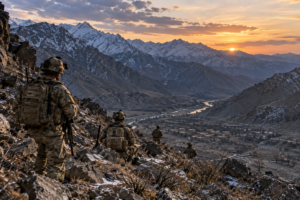
The U.S. Army’s archive of White’s story contains something particularly striking: photographs of the actual terrain around Aranas, including the trail where the ambush occurred and even an image identified as having been taken only moments before White and his unit were attacked. U.S. Army
Looking at that terrain helps explain the battle in a way that maps and citations cannot fully capture.
The mountains are steep. The routes are narrow. Cover is limited.
What began as a mission to meet village elders became, on the return journey, more than four hours of combat on an exposed mountainside.
Almost seven years later, a medal ceremony brought national attention to what happened there.
But the defining moment had occurred long before the ceremony—in a remote corner of Afghanistan, on a narrow trail leading back toward Bella.
Primary source: U.S. Army — Sgt. Kyle J. White Medal of Honor Archive